How to use this calculator
Estimate relative atmospheric path length with the secant-zenith approximation.
- Enter Zenith angle (degrees). Match the units shown beside each field and review the result together with the assumptions below.
- Read the worked example below to check the expected input format and result.
- Compare another scenario by changing one input at a time. Use Reset to return to the starting values.
Plane parallel atmospheric airmass explained
This guide follows plane parallel atmospheric airmass calculator from its stated formula through a worked example, then identifies the assumptions that bound the result.
Inputs, symbols, and units
z— Zenith angle (degrees)- Zenith angle (degrees).
Formula and method
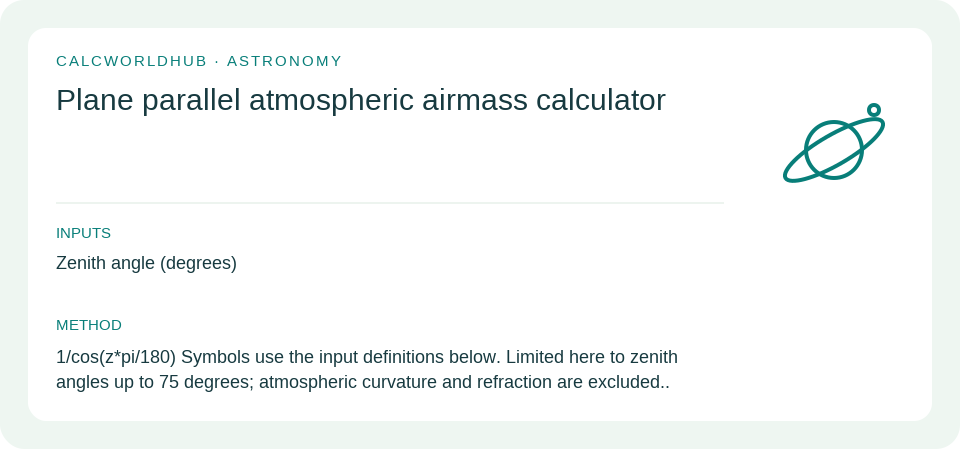
1/cos(z*pi/180)
Symbols use the input definitions below. Limited here to zenith angles up to 75 degrees; atmospheric curvature and refraction are excluded..
A worked scenario
Zenith angle (degrees) = 45.
- Plane parallel atmospheric airmass: 1.414214
This scenario uses the stated units and assumptions. Displayed values are rounded only after calculation.
Assumptions and edge cases
Limited here to zenith angles up to 75 degrees; atmospheric curvature and refraction are excluded.
Frequently asked questions
Is altitude the input?
No, zenith angle is 90° minus altitude.
Why reject the horizon?
The flat-atmosphere approximation breaks down.
Is airmass an air density?
No, it is relative path length.
How do I use the Plane parallel atmospheric airmass calculator?
Enter Zenith angle (degrees). Match the units shown beside each field and review the result together with the assumptions below.
What is a worked example of Plane parallel atmospheric airmass?
Zenith angle (degrees) = 45. Plane parallel atmospheric airmass: 1.414214 This scenario uses the stated units and assumptions. Displayed values are rounded only after calculation.
Read our calculation methodology.