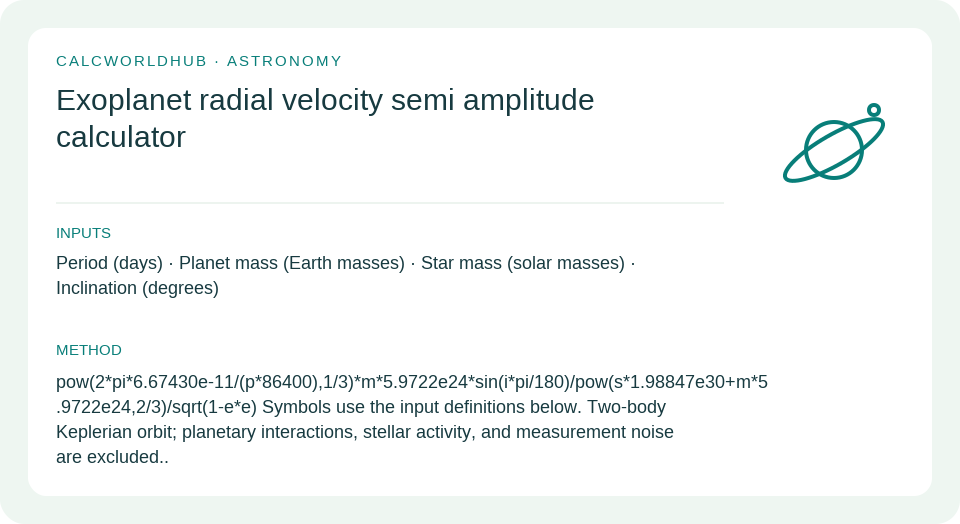
How to use this calculator
Estimate stellar line-of-sight velocity semi-amplitude induced by a single orbiting planet.
- Enter Period (days), Planet mass (Earth masses), Star mass (solar masses), Inclination (degrees), then complete the remaining labeled fields. Match the units shown beside each field and review the result together with the assumptions below.
- Read the worked example below to check the expected input format and result.
- Compare another scenario by changing one input at a time. Use Reset to return to the starting values.
Exoplanet radial velocity semi amplitude explained
For a Keplerian orbit, a planet makes its star move around the system barycentre and creates a periodic line-of-sight velocity signal. This model estimates the signal’s semi-amplitude from period, masses, inclination, and eccentricity; it assumes one planet and a two-body orbit.
Inputs, symbols, and units
p— Period (days)- Period (days).
m— Planet mass (Earth masses)- Planet mass (Earth masses).
s— Star mass (solar masses)- Star mass (solar masses).
i— Inclination (degrees)- Inclination (degrees).
e— Eccentricity- Eccentricity.
Formula and method
pow(2*pi*6.67430e-11/(p*86400),1/3)*m*5.9722e24*sin(i*pi/180)/pow(s*1.98847e30+m*5.9722e24,2/3)/sqrt(1-e*e)
Symbols use the input definitions below. Two-body Keplerian orbit; planetary interactions, stellar activity, and measurement noise are excluded..
A worked scenario
Period (days) = 365.25; Planet mass (Earth masses) = 1; Star mass (solar masses) = 1; Inclination (degrees) = 90; Eccentricity = 0.
- Exoplanet radial velocity semi amplitude: 0.089457 m/s
This scenario uses the stated units and assumptions. Displayed values are rounded only after calculation.
Assumptions and edge cases
Two-body Keplerian orbit; planetary interactions, stellar activity, and measurement noise are excluded.
Frequently asked questions
Why does inclination matter?
Only the line-of-sight motion is observed.
Is this peak-to-peak velocity?
No, peak-to-peak is twice the semi-amplitude.
Are default mass conversions exact?
They are fixed illustrative astronomical constants.
How do I use the Exoplanet radial velocity semi amplitude calculator?
Enter Period (days), Planet mass (Earth masses), Star mass (solar masses), Inclination (degrees), then complete the remaining labeled fields. Match the units shown beside each field and review the result together with the assumptions below.
What is a worked example of Exoplanet radial velocity semi amplitude?
Period (days) = 365.25; Planet mass (Earth masses) = 1; Star mass (solar masses) = 1; Inclination (degrees) = 90; Eccentricity = 0. Exoplanet radial velocity semi amplitude: 0.089457 m/s This scenario uses the stated units and assumptions. Displayed values are rounded only after calculation.
Read our calculation methodology.