Exponential hazard rate calculator
For an exponential waiting-time or lifetime model, the instantaneous hazard stays constant over elapsed time; this tool displays that rate.
inputs.
Calculator
How to use this calculator
Evaluate the constant hazard rate in an exponential model and see how the event-rate unit carries into the result.
- Complete the labeled inputs for Exponential hazard rate. Use the units requested by each field, then read the displayed result alongside the method and limits below.
- Read the worked example below to check the expected input format and result.
- Compare another scenario by changing one input at a time. Use Reset to return to the starting values.
A constant hazard under the exponential model
Formula and method
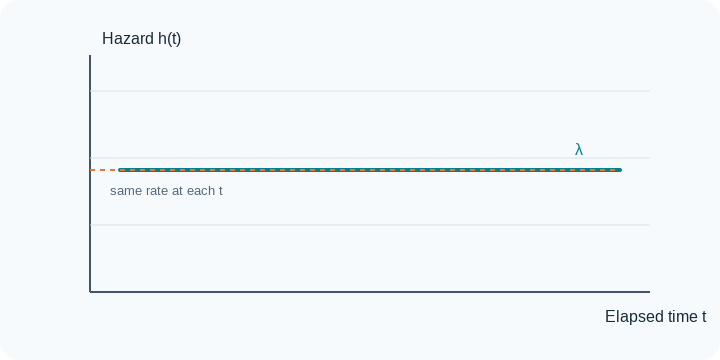
For t ≥ 0, the exponential hazard is h(t) = λ. The elapsed-time input identifies the point being discussed but does not change the numeric rate, because the model assumes constant hazard. Enter λ per unit of time.
Worked example
If the event rate is 0.12 per month, then at t = 5 months the hazard is 0.12 per month. Over a very short interval Δt, the conditional event probability is approximately λΔt, provided the interval is small.
Interpreting the result
A rate of 0.12 per month is an instantaneous conditional rate, not a 12% probability that an event occurs during every month. The probability over a finite interval comes from the survival model.
Assumptions and limits
The exponential distribution assumes a constant hazard and memoryless waiting times. Wear-out, learning, seasonality, changing exposure, or dependence among units can make that assumption unsuitable.
Sources and method notes
Read our calculation methodology.
Frequently asked questions
How do I use the Exponential hazard rate calculator?
Complete the labeled inputs for Exponential hazard rate. Use the units requested by each field, then read the displayed result alongside the method and limits below.
What is a worked example of Exponential hazard rate?
If the event rate is 0.12 per month, then at t = 5 months the hazard is 0.12 per month. Over a very short interval Δt, the conditional event probability is approximately λΔt, provided the interval is small.
What does the Exponential hazard rate calculator calculate?
Evaluate the constant hazard rate in an exponential model and see how the event-rate unit carries into the result.
What assumptions apply to Exponential hazard rate?
The exponential distribution assumes a constant hazard and memoryless waiting times. Wear-out, learning, seasonality, changing exposure, or dependence among units can make that assumption unsuitable.
Which method does the Exponential hazard rate calculator use?
For t ≥ 0, the exponential hazard is h(t) = λ. The elapsed-time input identifies the point being discussed but does not change the numeric rate, because the model assumes constant hazard. Enter λ per unit of time. The model’s hazard remains λ at each elapsed time.
Good calculators show their work.
CalcWorldHub is built around clear inputs and visible assumptions. Results are estimates for planning; check official sources or your provider’s terms when exact figures matter.