Exponential survival probability calculator
Estimate the share of modeled lifetimes that extend beyond time t when the event process has a constant rate λ.
inputs.
Calculator
How to use this calculator
Find the probability that an exponential waiting time or lifetime exceeds the entered elapsed time at a constant event rate.
- Complete the labeled inputs for Exponential survival probability. Use the units requested by each field, then read the displayed result alongside the method and limits below.
- Read the worked example below to check the expected input format and result.
- Compare another scenario by changing one input at a time. Use Reset to return to the starting values.
Reading the exponential survival probability
Formula and method
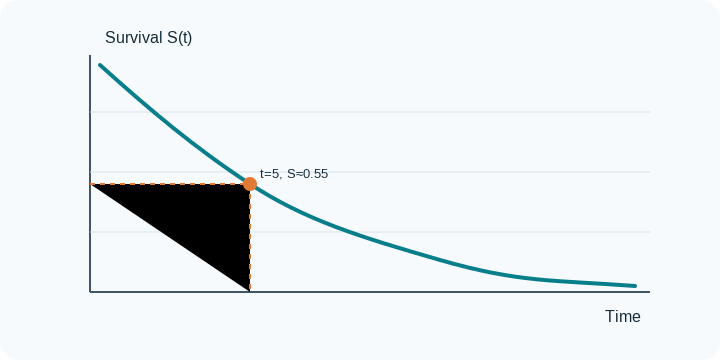
The survival function is S(t) = e^(−λt), where t is elapsed time and λ is the event rate in reciprocal time units. The product λt must be dimensionless.
Worked example
At λ = 0.12 per month and t = 5 months, S(t) = e^(−0.12 × 5) = e^(−0.6) ≈ 0.5488. About 54.88% of modeled waiting times exceed five months.
Interpreting the result
The complementary probability, 1 − S(t) ≈ 0.4512, is the chance that the event has occurred by five months under this model. A survival value is a population-model probability, not a promise for an individual unit.
Assumptions and limits
This curve assumes one constant hazard over the interval and a valid time origin. Competing risks, changing conditions, censoring, or a hazard that changes with age call for a different survival model.
Sources and method notes
Read our calculation methodology.
Frequently asked questions
How do I use the Exponential survival probability calculator?
Complete the labeled inputs for Exponential survival probability. Use the units requested by each field, then read the displayed result alongside the method and limits below.
What is a worked example of Exponential survival probability?
At λ = 0.12 per month and t = 5 months, S(t) = e^(−0.12 × 5) = e^(−0.6) ≈ 0.5488. About 54.88% of modeled waiting times exceed five months.
What does the Exponential survival probability calculator calculate?
Find the probability that an exponential waiting time or lifetime exceeds the entered elapsed time at a constant event rate.
What assumptions apply to Exponential survival probability?
This curve assumes one constant hazard over the interval and a valid time origin. Competing risks, changing conditions, censoring, or a hazard that changes with age call for a different survival model.
Which method does the Exponential survival probability calculator use?
The survival function is S(t) = e^(−λt), where t is elapsed time and λ is the event rate in reciprocal time units. The product λt must be dimensionless. A larger λ makes the modeled survival curve fall more quickly.
Good calculators show their work.
CalcWorldHub is built around clear inputs and visible assumptions. Results are estimates for planning; check official sources or your provider’s terms when exact figures matter.