Eyepiece true field of view calculator
Estimate sky coverage from eyepiece apparent field and telescope magnification. Enter your values below to see the result and method.
inputs.
Related calculators
These tools cover nearby questions while keeping this page focused on its own calculation.
How to use this calculator
Estimate sky coverage from eyepiece apparent field and telescope magnification.
- Enter Eyepiece apparent field (degrees), Telescope magnification (×). Match the units shown beside each field and review the result together with the assumptions below.
- Read the worked example below to check the expected input format and result.
- Compare another scenario by changing one input at a time. Use Reset to return to the starting values.
Start with the optical quantity you know
Use this observing calculation to relate telescope optics to angular coverage or collected light. Estimate sky coverage from eyepiece apparent field and telescope magnification.
Inputs and units
Enter the values below for this model. Nominal apparent angular field stated for the eyepiece, before accounting for field-stop geometry or distortion. Nominal angular magnification of the telescope–eyepiece combination, expressed as a ratio.
- Eyepiece apparent field (degrees): Nominal apparent angular field stated for the eyepiece, before accounting for field-stop geometry or distortion.
- Telescope magnification (×): Nominal angular magnification of the telescope–eyepiece combination, expressed as a ratio.
Telescope equation and example
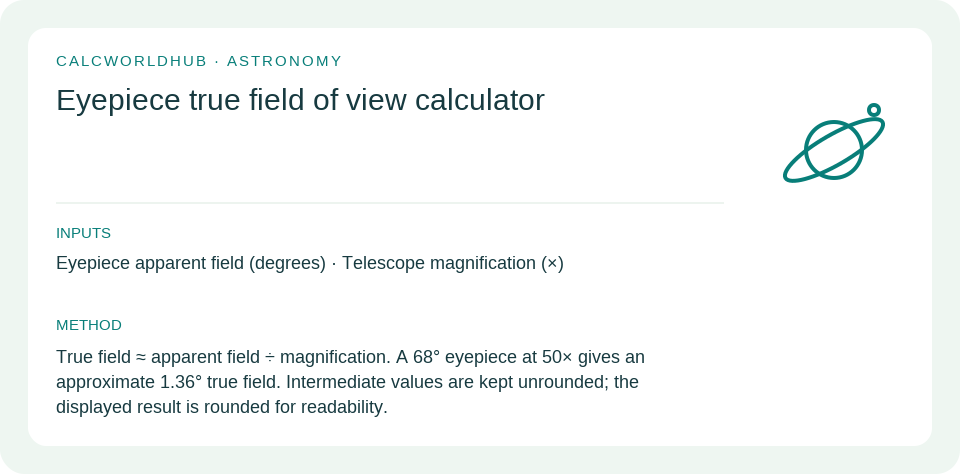
True field ≈ apparent field ÷ magnification.
A 68° eyepiece at 50× gives an approximate 1.36° true field.
Intermediate values are kept unrounded; the displayed result is rounded for readability.
Ideal optics versus an observing night
The result describes an ideal geometric or diffraction limit. Seeing, focus, transmission, obstruction, and detector sampling can set a less favorable practical limit.
Assumptions and limitations
Uses the simple apparent-field approximation; distortion and eyepiece field-stop geometry can change the actual field.
Frequently asked questions
How do apparent field and magnification set the estimated sky view?
True field ≈ apparent field ÷ magnification. A 68° eyepiece at 50× gives an approximate 1.36° true field.
Does this eyepiece true field of view include real-world effects?
Uses the simple apparent-field approximation; distortion and eyepiece field-stop geometry can change the actual field.
How do I use the Eyepiece true field of view calculator?
Enter Eyepiece apparent field (degrees), Telescope magnification (×). Match the units shown beside each field and review the result together with the assumptions below.
What is a worked example of Eyepiece true field of view?
True field ≈ apparent field ÷ magnification. A 68° eyepiece at 50× gives an approximate 1.36° true field. Intermediate values are kept unrounded; the displayed result is rounded for readability.
What does the Eyepiece true field of view calculator calculate?
Estimate sky coverage from eyepiece apparent field and telescope magnification.
Read the calculation methodology and privacy policy.