Small-angle angular size calculator
Estimate an object’s angular size when it is small relative to its distance.
Related calculators and articles
Compare methods and explore more free tools in astronomy.
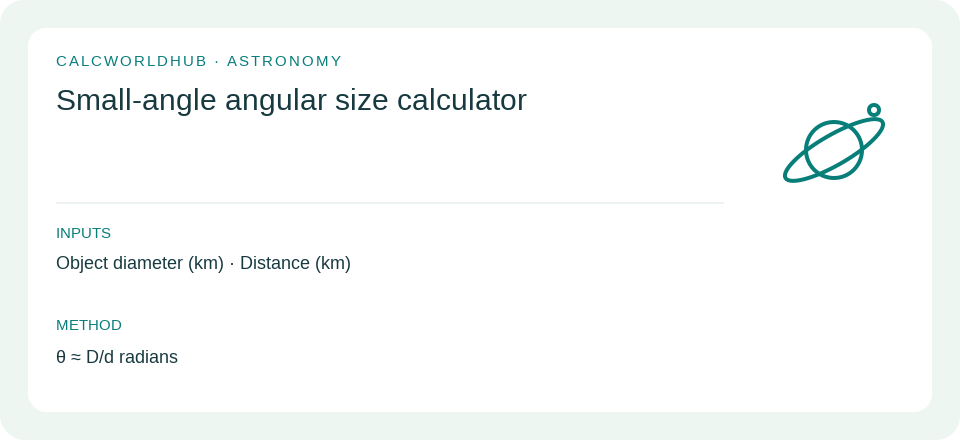
How to use this calculator
Estimate an object’s angular size when it is small relative to its distance.
- Enter Object diameter (km), Distance (km). Match the units shown beside each field and review the result together with the assumptions below.
- Read the worked example below to check the expected input format and result.
- Compare another scenario by changing one input at a time. Use Reset to return to the starting values.
Small-angle angular size calculator
Estimate an object’s angular size when it is small relative to its distance.
Inputs and units
- Object diameter (km): Physical diameter transverse to the line of sight; it must use the same length unit as distance.
- Distance (km): Center-to-observer distance in kilometres; much larger than object diameter for the small-angle approximation.
Formula and method
θ ≈ D/d radians
Worked example
A 1,200 km object at 384,400 km subtends θ≈1200/384400=0.00312 rad≈0.179°.
Interpreting the result
The ratio is an angle in radians under the small-angle approximation; it is not a physical diameter or distance by itself.
Assumptions and limits
Diameter must be nonnegative and distance positive, both in the same units. Accuracy declines as D/d grows; use 2 arctan(D/(2d)) for larger angles.
Sources and method
- Derives angular size from object size over distance under the small-angle approximation. The example is independently recomputed. OpenStax University Physics Volume 3: circular apertures and resolution
Frequently asked questions
What does this small angle angular size result tell me?
The ratio is an angle in radians under the small-angle approximation; it is not a physical diameter or distance by itself.
What assumptions should I check?
Diameter must be nonnegative and distance positive, both in the same units. Accuracy declines as D/d grows; use 2 arctan(D/(2d)) for larger angles.
How do I use the Small-angle angular size calculator?
Enter Object diameter (km), Distance (km). Match the units shown beside each field and review the result together with the assumptions below.
What is a worked example of Small-angle angular size?
A 1,200 km object at 384,400 km subtends θ≈1200/384400=0.00312 rad≈0.179°.
What does the Small-angle angular size calculator calculate?
Estimate an object’s angular size when it is small relative to its distance.
See the calculation methodology.