Factorial calculator
Calculate the product of the integers from one through n.
Calculator
How to use this calculator
Calculate n! by multiplying the positive integers through a nonnegative whole-number input.
- Enter Nonnegative integer n. Match the units shown beside each field and review the result together with the assumptions below.
- Read the worked example below to check the expected input format and result.
- Compare another scenario by changing one input at a time. Use Reset to return to the starting values.
Multiply the integers from one through n
The factorial n! is the product of every positive integer up to a nonnegative whole number n.
Inputs and units
- Nonnegative integer n: Enter a whole number in the range accepted by the calculator.
Formula and method
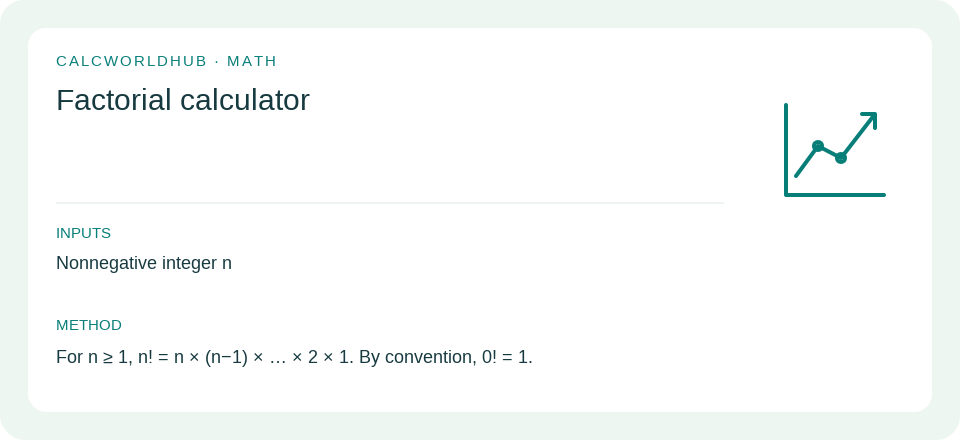
For n ≥ 1, n! = n × (n−1) × … × 2 × 1. By convention, 0! = 1.
Worked example
For n = 6, 6! = 6 × 5 × 4 × 3 × 2 × 1 = 720.
Interpreting the result
Factorials grow quickly and appear in arrangements, combinations, and probability calculations. The result is an exact integer within the calculator’s supported range.
Assumptions and limits
This page computes integer factorials only. Large factorials can exceed the supported numeric range; a rounded floating-point display is not an arbitrary-precision result.
Method references
Frequently asked questions
Why is 0! equal to 1?
It is the multiplicative identity used by the factorial recurrence and counting formulas; the empty product is 1.
Can I enter a decimal?
No. Factorial here is defined for nonnegative whole numbers.
How do I use the Factorial calculator?
Enter Nonnegative integer n. Match the units shown beside each field and review the result together with the assumptions below.
What is a worked example of Factorial?
For n = 6, 6! = 6 × 5 × 4 × 3 × 2 × 1 = 720.
What does the Factorial calculator calculate?
Calculate n! by multiplying the positive integers through a nonnegative whole-number input.
Good calculators show their work.
CalcWorldHub is built around clear inputs and visible assumptions. Results are estimates for planning; check official sources or your provider’s terms when exact figures matter.