Fibonacci term calculator
Find a Fibonacci number using the zero-indexed sequence convention.
Calculator
How to use this calculator
Find a zero-indexed Fibonacci term using F₀ = 0, F₁ = 1, and the two-term recurrence.
- Enter Index n (starting at 0). Match the units shown beside each field and review the result together with the assumptions below.
- Read the worked example below to check the expected input format and result.
- Compare another scenario by changing one input at a time. Use Reset to return to the starting values.
Find a term in the zero-indexed Fibonacci sequence
This calculator uses the sequence F₀ = 0, F₁ = 1, with each later term equal to the sum of the two terms before it.
Inputs and units
- Index n (starting at 0): Enter a nonnegative whole-number position; index 0 returns the first term, 0.
Formula and method
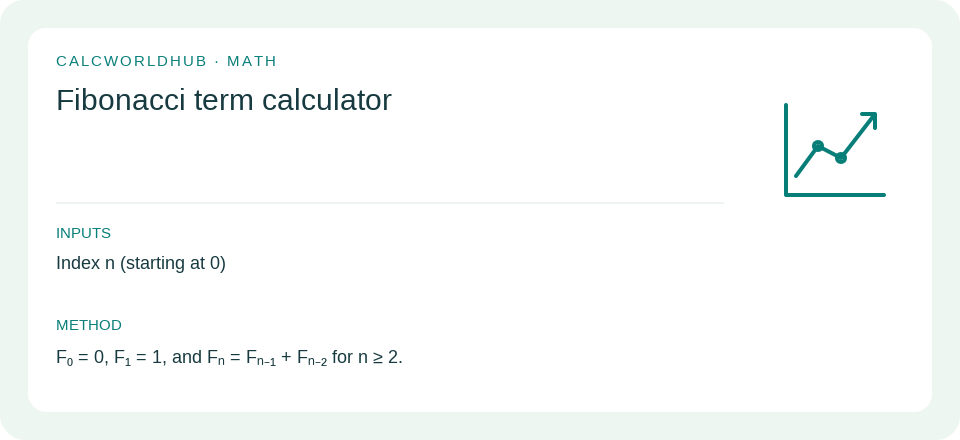
F₀ = 0, F₁ = 1, and Fₙ = Fₙ₋₁ + Fₙ₋₂ for n ≥ 2.
Worked example
Starting 0, 1, 1, 2, 3, 5, 8, 13, 21, 34, the index-10 term is 55.
Interpreting the result
The index convention matters: a one-based list would call 0 the first item, while this page labels it F₀.
Assumptions and limits
The sequence is deterministic and grows rapidly. This page returns one term; it does not estimate a natural pattern or predict a real-world process.
Method references
Frequently asked questions
Why is the index zero-based?
The recurrence is defined with F₀ = 0 and F₁ = 1, so the input uses those same positions.
Does the sequence start 0, 1, 1 or 1, 1, 2?
Both lists occur under different starting conventions. This calculator explicitly uses F₀ = 0, F₁ = 1.
How do I use the Fibonacci term calculator?
Enter Index n (starting at 0). Match the units shown beside each field and review the result together with the assumptions below.
What is a worked example of Fibonacci term?
Starting 0, 1, 1, 2, 3, 5, 8, 13, 21, 34, the index-10 term is 55.
What does the Fibonacci term calculator calculate?
Find a zero-indexed Fibonacci term using F₀ = 0, F₁ = 1, and the two-term recurrence.
Good calculators show their work.
CalcWorldHub is built around clear inputs and visible assumptions. Results are estimates for planning; check official sources or your provider’s terms when exact figures matter.