How to use this calculator
Estimate fan electrical power and annual energy cost from airflow, pressure rise, efficiency, and operating hours.
- Enter Airflow (CFM), Pressure rise (in. water), Total fan-system efficiency (%), Operating hours per day, then complete the remaining labeled fields. Match the units shown beside each field and review the result together with the assumptions below.
- Read the worked example below to check the expected input format and result.
- Compare another scenario by changing one input at a time. Use Reset to return to the starting values.
How this calculation works
Air power is the product of volumetric airflow and pressure rise. Dividing by total fan-system efficiency estimates electrical input. The tool converts CFM and inches of water to SI units before calculating annual consumption.
Inputs and units
cfm— Airflow (CFM)- Volumetric flow in cubic feet per minute.
pressure— Pressure rise (in. water)- Pressure increase across the fan system.
efficiency— Total fan-system efficiency (%)- Electrical input divided by air power.
hours— Operating hours per day- Average daily operating time.
days— Operating days per year- Number of operating days.
rate— Electricity price ($/kWh)- Variable electricity price for the estimate.
Formula
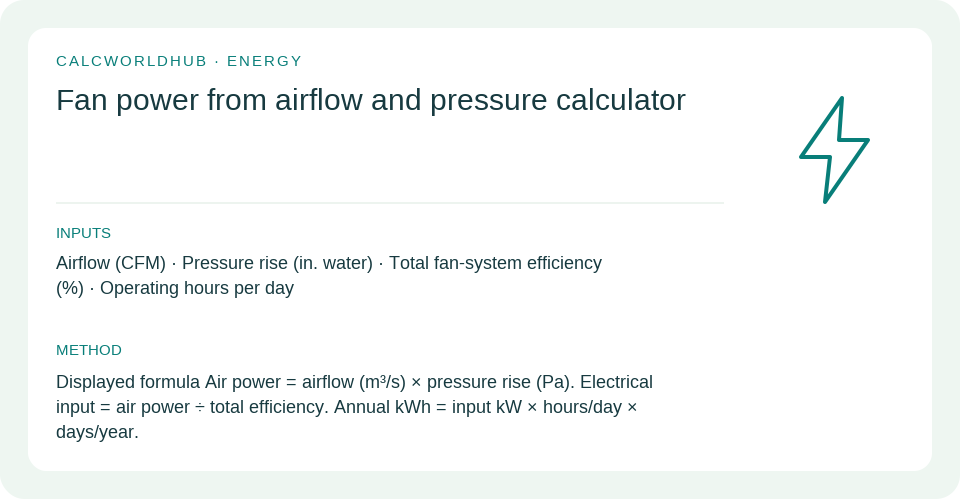
Air power = airflow (m³/s) × pressure rise (Pa). Electrical input = air power ÷ total efficiency. Annual kWh = input kW × hours/day × days/year.
Method
Enter flow, pressure rise, total efficiency, operating schedule, and electricity price for one representative operating point.
Worked example
At 2,000 CFM and 0.50 in. water, air power is about 117.6 W. At 60% efficiency, input is 195.9 W; 8 hours/day for 300 days uses about 470.2 kWh/year.
Assumptions and limits
Actual input depends on the fan and system curves, motor and drive losses, control settings, and air density. Static pressure may not equal total pressure for every installation; confirm the operating point from equipment data.
Frequently asked questions
Why is input higher than air power?
The efficiency adjustment accounts for losses between electricity input and air power.
Is static pressure the same as total pressure?
Not always. Use a pressure value consistent with equipment data.
Does annual cost include demand charges?
No. It uses the kWh rate entered.
How do I use the Fan power from airflow and pressure calculator?
Enter Airflow (CFM), Pressure rise (in. water), Total fan-system efficiency (%), Operating hours per day, then complete the remaining labeled fields. Match the units shown beside each field and review the result together with the assumptions below.
What is a worked example of Fan power from airflow and pressure?
At 2,000 CFM and 0.50 in. water, air power is about 117.6 W. At 60% efficiency, input is 195.9 W; 8 hours/day for 300 days uses about 470.2 kWh/year.
Reference: U.S. Department of Energy fans and blowers overview. See our calculation methodology.