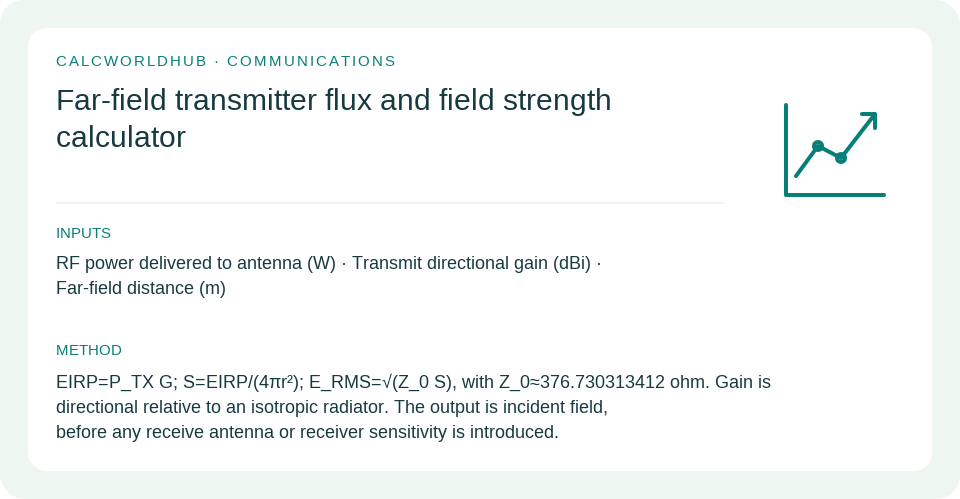
How to use this calculator
Estimate directional incident RF flux and RMS electric field from transmitter power and far-field range.
- Enter RF power delivered to antenna (W), Transmit directional gain (dBi), Far-field distance (m). Match the units shown beside each field and review the result together with the assumptions below.
- Read the worked example below to check the expected input format and result.
- Compare another scenario by changing one input at a time. Use Reset to return to the starting values.
Far-field transmitter flux and field strength explained
In the unobstructed far field, directional EIRP sets power carried by the wavefront. Flux falls with distance squared, and RMS electric field follows free-space wave impedance; antenna direction and far-field conditions matter.
Inputs, symbols, and units
P— RF power delivered to antenna (W)- Power after feeder losses.
G— Transmit directional gain (dBi)- Antenna gain toward the observation point.
r— Far-field distance (m)- Radial observation distance in unobstructed space.
Formula and method
EIRP=P_TX G; S=EIRP/(4πr²); E_RMS=√(Z_0 S), with Z_0≈376.730313412 ohm.
Gain is directional relative to an isotropic radiator. The output is incident field, before any receive antenna or receiver sensitivity is introduced.
A worked scenario
RF power delivered to antenna (W) = 10; Transmit directional gain (dBi) = 15; Far-field distance (m) = 1000.
- Power flux density: 0.000025 W/m2
- RMS electric field: 0.097367 V/m
- Directional EIRP: 316.227766 W
Ten watts delivered to a 15 dBi antenna are spread over a spherical wavefront at 1 km in the chosen direction.
Assumptions and edge cases
Free-space far field only. Near-field coupling, reflections, duty-cycle averaging and exposure compliance standards are not modeled.
Reading the outputs
Flux is watts per square metre, field is RMS volts per metre and EIRP is isotropic-equivalent directional power.
Frequently asked questions
Is RMS field a peak field?
No; a sinusoidal peak field is sqrt(2) times its RMS value.
Can I use this beside the antenna surface?
No; near-field structure may invalidate the spherical far-field relation.
Does zero transmitter power work?
Yes; flux, field and EIRP all return zero.
How do I use the Far-field transmitter flux and field strength calculator?
Enter RF power delivered to antenna (W), Transmit directional gain (dBi), Far-field distance (m). Match the units shown beside each field and review the result together with the assumptions below.
What is a worked example of Far-field transmitter flux and field strength?
RF power delivered to antenna (W) = 10; Transmit directional gain (dBi) = 15; Far-field distance (m) = 1000. Power flux density: 0.000025 W/m2 RMS electric field: 0.097367 V/m Directional EIRP: 316.227766 W Ten watts delivered to a 15 dBi antenna are spread over a spherical wavefront at 1 km in the chosen direction.
Read our calculation methodology.