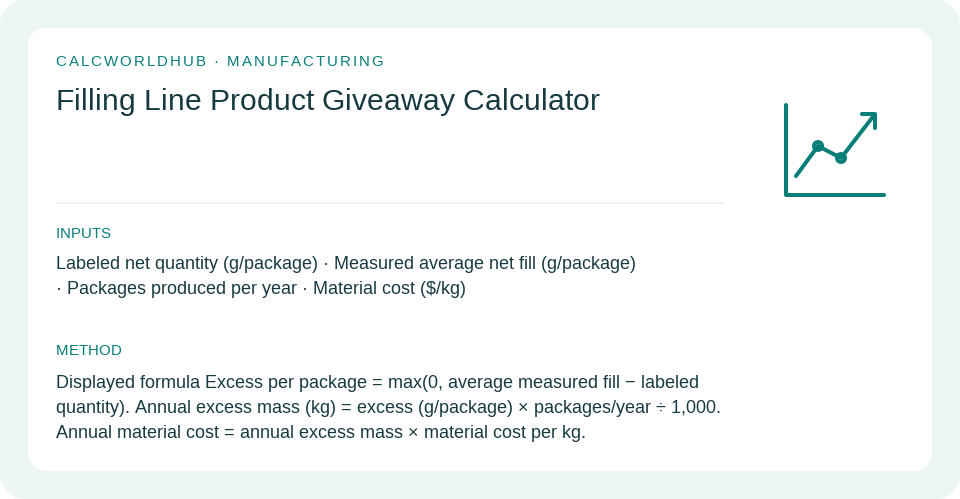
How to use this calculator
Estimate annual material cost from average package overfill, production volume, and ingredient cost.
- Enter Labeled net quantity (g/package), Measured average net fill (g/package), Packages produced per year, Material cost ($/kg). Match the units shown beside each field and review the result together with the assumptions below.
- Read the worked example below to check the expected input format and result.
- Compare another scenario by changing one input at a time. Use Reset to return to the starting values.
How this calculation works
Average fill above the labeled target can consume material across every unit in a production run. This estimator converts the measured average excess into annual mass and cost so a team can size a process-improvement opportunity.
Inputs and units
labelGrams— Labeled net quantity (g/package)- Declared net product amount, excluding packaging.
averageFillGrams— Measured average net fill (g/package)- Average product quantity from a representative measurement sample.
packagesPerYear— Packages produced per year- Annual units for this product and fill process.
materialCostPerKg— Material cost ($/kg)- Variable product-material cost per kilogram; exclude package and labor cost.
Formula
Excess per package = max(0, average measured fill − labeled quantity). Annual excess mass (kg) = excess (g/package) × packages/year ÷ 1,000. Annual material cost = annual excess mass × material cost per kg.
Method
Enter one product's labeled net quantity, its measured average net fill over a representative sample, annual package count, and material cost per kilogram. Only positive average overfill is counted as giveaway.
Worked example
For a 500 g label and a measured average fill of 506 g, the excess is 6 g per package. At 1,000,000 packages per year, that is 6,000 kg. At $8/kg, estimated annual material cost is $48,000.
Assumptions and limits
This is a material-cost estimate, not a package-compliance test. It does not evaluate individual package variation, measurement uncertainty, tare, production downtime, or rules that apply in a jurisdiction. NIST Handbook 133 describes average and individual package requirements; a passing average alone does not establish compliance.
Frequently asked questions
Does this determine whether packages comply with weights-and-measures rules?
No. It estimates material above the label average only. Legal checks can also consider individual package variation, sampling procedures, and measurement requirements.
What if the average measured fill is below the label quantity?
The page reports the negative average difference but counts zero giveaway; it is not an underfill or compliance assessment.
Should cost include the container?
No. Enter the variable cost of the product material only if you want the value of excess product; package and labor costs are outside this formula.
How should I choose the measured average?
Use a representative sample collected with a suitable, calibrated process; a single package is not a reliable estimate of a production average.
How do I use the Filling Line Product Giveaway Calculator?
Enter Labeled net quantity (g/package), Measured average net fill (g/package), Packages produced per year, Material cost ($/kg). Match the units shown beside each field and review the result together with the assumptions below.
Reference: NIST guidance on average and individual net-content requirements for packaged goods. See our calculation methodology.