How to use this calculator
Find the maximum reversible work available as a finite hot or cold solid comes to equilibrium with its environment.
- Enter Body mass (kg), Constant heat capacity (kJ/kg/K), Uniform body temperature (K), Environment temperature (K). Match the units shown beside each field and review the result together with the assumptions below.
- Read the worked example below to check the expected input format and result.
- Compare another scenario by changing one input at a time. Use Reset to return to the starting values.
Finite solid thermal exergy relative to ambient explained
Use Body mass (kg) with Constant heat capacity (kJ/kg/K) to reproduce the sample calculation, then review the stated limits before carrying the result into another scenario.
Inputs, symbols, and units
m— Body mass (kg)- Body mass (kg). Enter the value for this state; the units shown are used without an unstated conversion.
cp— Constant heat capacity (kJ/kg/K)- Constant heat capacity (kJ/kg/K). Enter the value for this state; the units shown are used without an unstated conversion.
T— Uniform body temperature (K)- Uniform body temperature (K). Enter the value for this state; the units shown are used without an unstated conversion.
T0— Environment temperature (K)- Environment temperature (K). Enter the value for this state; the units shown are used without an unstated conversion.
Formula and method
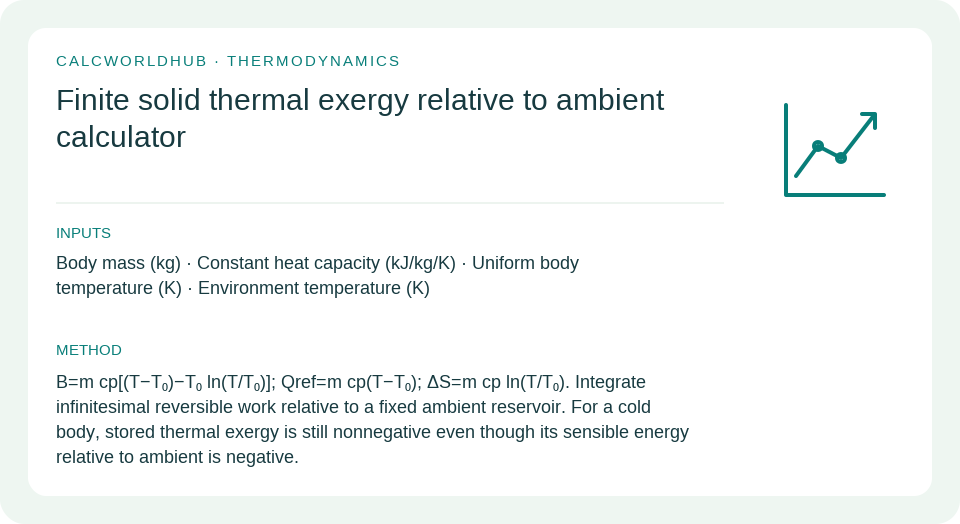
B=m cp[(T−T₀)−T₀ ln(T/T₀)]; Qref=m cp(T−T₀); ΔS=m cp ln(T/T₀).
Integrate infinitesimal reversible work relative to a fixed ambient reservoir. For a cold body, stored thermal exergy is still nonnegative even though its sensible energy relative to ambient is negative.
A worked scenario
Body mass (kg) = 25; Constant heat capacity (kJ/kg/K) = 0.9; Uniform body temperature (K) = 500; Environment temperature (K) = 300.
- Thermal exergy: 1051.92704 kJ
- Sensible energy relative to ambient: 4500 kJ
- Entropy relative to ambient: 11.493577 kJ/K
A 25 kg body with cp=0.9 kJ/kg/K at 500 K stores 4,500 kJ above a 300 K environment. Only 1,051.93 kJ is reversible work availability as it cools; the remaining energy cannot all be converted to work.
Assumptions and edge cases
Uniform incompressible body, constant heat capacity, no phase change, chemical reaction, pressure exergy or ambient temperature drift.
Reading the outputs
Thermal exergy is available work in kJ. Sensible energy and entropy are signed differences from ambient.
Frequently asked questions
Can a cold body have exergy?
Yes. A temperature difference in either direction can support reversible work.
Why is exergy smaller than stored heat for a hot body?
Some energy must be rejected to the environment while producing work.
Is this electrical energy I will actually obtain?
No. Real conversion losses reduce the reversible maximum.
How do I use the Finite solid thermal exergy relative to ambient calculator?
Enter Body mass (kg), Constant heat capacity (kJ/kg/K), Uniform body temperature (K), Environment temperature (K). Match the units shown beside each field and review the result together with the assumptions below.
What is a worked example of Finite solid thermal exergy relative to ambient?
Body mass (kg) = 25; Constant heat capacity (kJ/kg/K) = 0.9; Uniform body temperature (K) = 500; Environment temperature (K) = 300. Thermal exergy: 1051.92704 kJ Sensible energy relative to ambient: 4500 kJ Entropy relative to ambient: 11.493577 kJ/K A 25 kg body with cp=0.9 kJ/kg/K at 500 K stores 4,500 kJ above a 300 K environment. Only 1,051.93 kJ is reversible work availability as it cools; the remaining energy cannot all be converted to work.
Read our calculation methodology.