How to use this calculator
Quantify the loss of useful work potential when finite hot and cold liquids are allowed to equilibrate directly.
- Enter Liquid 1 mass (kg), Liquid 1 cp (kJ/kg/K), Liquid 1 initial temperature (K), Liquid 2 mass (kg), then complete the remaining labeled fields. Match the units shown beside each field and review the result together with the assumptions below.
- Read the worked example below to check the expected input format and result.
- Compare another scenario by changing one input at a time. Use Reset to return to the starting values.
Finite liquid thermal mixing entropy generation explained
Inputs, symbols, and units
m1— Liquid 1 mass (kg)- Liquid 1 mass (kg). Enter the value for this state; the units shown are used without an unstated conversion.
cp1— Liquid 1 cp (kJ/kg/K)- Liquid 1 cp (kJ/kg/K). Enter the value for this state; the units shown are used without an unstated conversion.
T1— Liquid 1 initial temperature (K)- Liquid 1 initial temperature (K). Enter the value for this state; the units shown are used without an unstated conversion.
m2— Liquid 2 mass (kg)- Liquid 2 mass (kg). Enter the value for this state; the units shown are used without an unstated conversion.
cp2— Liquid 2 cp (kJ/kg/K)- Liquid 2 cp (kJ/kg/K). Enter the value for this state; the units shown are used without an unstated conversion.
T2— Liquid 2 initial temperature (K)- Liquid 2 initial temperature (K). Enter the value for this state; the units shown are used without an unstated conversion.
T0— Environment temperature (K)- Environment temperature (K). Enter the value for this state; the units shown are used without an unstated conversion.
Formula and method
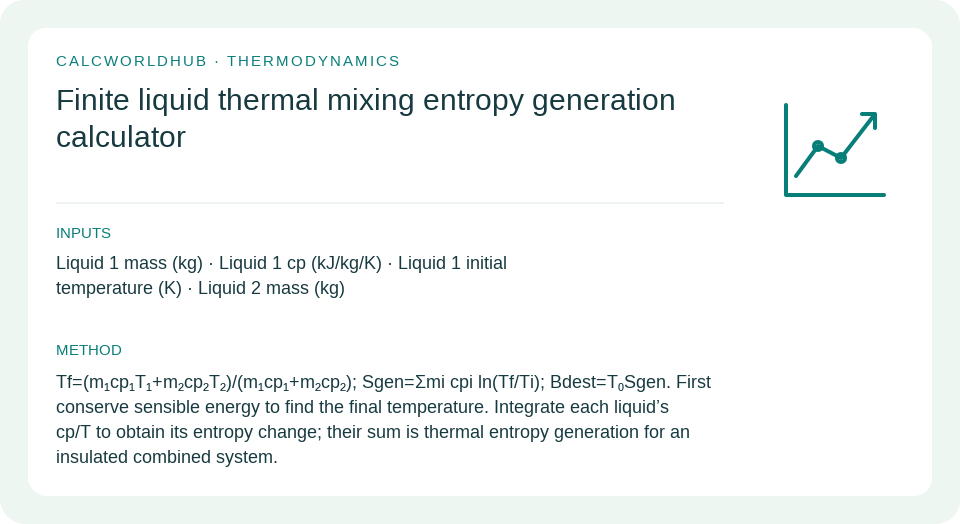
Tf=(m₁cp₁T₁+m₂cp₂T₂)/(m₁cp₁+m₂cp₂); Sgen=Σmi cpi ln(Tf/Ti); Bdest=T₀Sgen.
First conserve sensible energy to find the final temperature. Integrate each liquid’s cp/T to obtain its entropy change; their sum is thermal entropy generation for an insulated combined system.
A worked scenario
Liquid 1 mass (kg) = 2; Liquid 1 cp (kJ/kg/K) = 4.18; Liquid 1 initial temperature (K) = 350; Liquid 2 mass (kg) = 3; Liquid 2 cp (kJ/kg/K) = 4.18; Liquid 2 initial temperature (K) = 290; Environment temperature (K) = 298.15.
- Adiabatic mixed temperature: 314 K
- Thermal entropy generation: 0.089685 kJ/K
- Thermal exergy destroyed: 26.73972 kJ
Mix 2 kg of liquid at 350 K with 3 kg at 290 K, both with cp=4.18 kJ/kg/K. The common temperature is 314 K; entropy generation 0.0896855 kJ/K destroys 26.7397 kJ work potential at a 298.15 K environment.
Assumptions and edge cases
Incompressible constant-cp liquids with no phase change, reaction or heat of solution. Chemical mixing entropy is excluded; use identical liquid or immiscible thermally contacting bodies for a purely thermal interpretation.
Reading the outputs
Returns final temperature, total thermal entropy generation and ambient-reference exergy destruction.
Frequently asked questions
Why use absolute temperatures in logarithms?
Entropy integration requires thermodynamic temperature ratios in kelvin.
Does equal starting temperature produce zero loss?
Yes, when only thermal equilibration is modeled.
Can different liquids release heat of mixing?
Yes. That effect is excluded and requires additional thermodynamic data.
How do I use the Finite liquid thermal mixing entropy generation calculator?
Enter Liquid 1 mass (kg), Liquid 1 cp (kJ/kg/K), Liquid 1 initial temperature (K), Liquid 2 mass (kg), then complete the remaining labeled fields. Match the units shown beside each field and review the result together with the assumptions below.
What is a worked example of Finite liquid thermal mixing entropy generation?
Liquid 1 mass (kg) = 2; Liquid 1 cp (kJ/kg/K) = 4.18; Liquid 1 initial temperature (K) = 350; Liquid 2 mass (kg) = 3; Liquid 2 cp (kJ/kg/K) = 4.18; Liquid 2 initial temperature (K) = 290; Environment temperature (K) = 298.15. Adiabatic mixed temperature: 314 K Thermal entropy generation: 0.089685 kJ/K Thermal exergy destroyed: 26.73972 kJ Mix 2 kg of liquid at 350 K with 3 kg at 290 K, both with cp=4.18 kJ/kg/K. The common temperature is 314 K; entropy generation 0.0896855 kJ/K destroys 26.7397 kJ work potential at a 298.15 K environment.
Read our calculation methodology.