How to use this calculator
Measure frequency-dependent delay from a stable first-order all-pass section whose magnitude is unity.
- Enter Real all-pass coefficient a, Signal frequency (Hz), Sampling rate (Hz). Match the units shown beside each field and review the result together with the assumptions below.
- Read the worked example below to check the expected input format and result.
- Compare another scenario by changing one input at a time. Use Reset to return to the starting values.
First order all pass phase and group delay explained
A first-order all-pass filter preserves magnitude while changing phase; its group delay is the local phase slope at the entered frequency.
How the calculation works
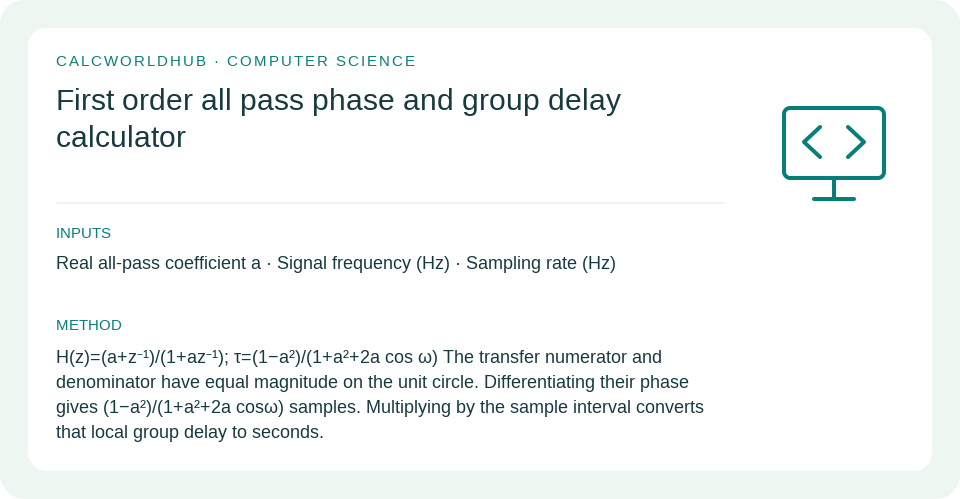
H(z)=(a+z⁻¹)/(1+az⁻¹); τ=(1−a²)/(1+a²+2a cos ω)
The transfer numerator and denominator have equal magnitude on the unit circle. Differentiating their phase gives (1−a²)/(1+a²+2a cosω) samples. Multiplying by the sample interval converts that local group delay to seconds.
Set up the calculation
a— Real all-pass coefficient a- Real all-pass coefficient a.
f— Signal frequency (Hz)- Signal frequency (Hz).
fs— Sampling rate (Hz)- Sampling rate (Hz).
Limits of this model
Real coefficient with |a|<1; group delay is the local phase derivative, not the travel time of every possible waveform.
Check this example
Real all-pass coefficient a = 0.5; Signal frequency (Hz) = 1000; Sampling rate (Hz) = 48000.
- All-pass group delay: 0.3346056 samples
- Group delay in seconds: 0.0000069709 s
- Principal phase: -2.50317764 degrees
At 1 kHz with a 48 kHz sampling rate, the local delay is about 0.3346 samples (6.97 μs).
Frequently asked questions
Does it alter steady sinusoid amplitude?
The ideal magnitude is one.
Is group delay in seconds?
The main result is samples; seconds are also shown.
Can a be exactly one?
The strict stable nondegenerate section excludes unit-magnitude coefficients.
How do I use the First order all pass phase and group delay calculator?
Enter Real all-pass coefficient a, Signal frequency (Hz), Sampling rate (Hz). Match the units shown beside each field and review the result together with the assumptions below.
What is a worked example of First order all pass phase and group delay?
Real all-pass coefficient a = 0.5; Signal frequency (Hz) = 1000; Sampling rate (Hz) = 48000. All-pass group delay: 0.3346056 samples Group delay in seconds: 0.0000069709 s Principal phase: -2.50317764 degrees At 1 kHz with a 48 kHz sampling rate, the local delay is about 0.3346 samples (6.97 μs).
Read our calculation methodology.