How to use this calculator
Estimate a first-order BOD deoxygenation coefficient from measured exerted BOD and an ultimate-demand value.
- Enter Exerted BOD at test time (mg/L), Ultimate BOD, L₀ (mg/L), Elapsed test time (days). Match the units shown beside each field and review the result together with the assumptions below.
- Read the worked example below to check the expected input format and result.
- Compare another scenario by changing one input at a time. Use Reset to return to the starting values.
How this calculation works
Stream-quality and wastewater models often describe remaining carbonaceous biochemical oxygen demand with first-order kinetics. When an ultimate BOD value is available independently, one measured exerted amount at a known elapsed time can be used to estimate the base-e rate coefficient for that interval.
Inputs and units
bodAtTimeMgL— Exerted BOD at test time (mg/L)- Measured oxygen demand exerted by elapsed time t, on the same sample basis as ultimate BOD.
ultimateBodMgL— Ultimate BOD, L₀ (mg/L)- Independently estimated ultimate demand; must exceed the measured exerted BOD.
elapsedDays— Elapsed test time (days)- Time between the start of the model interval and the exerted-BOD measurement.
Formula
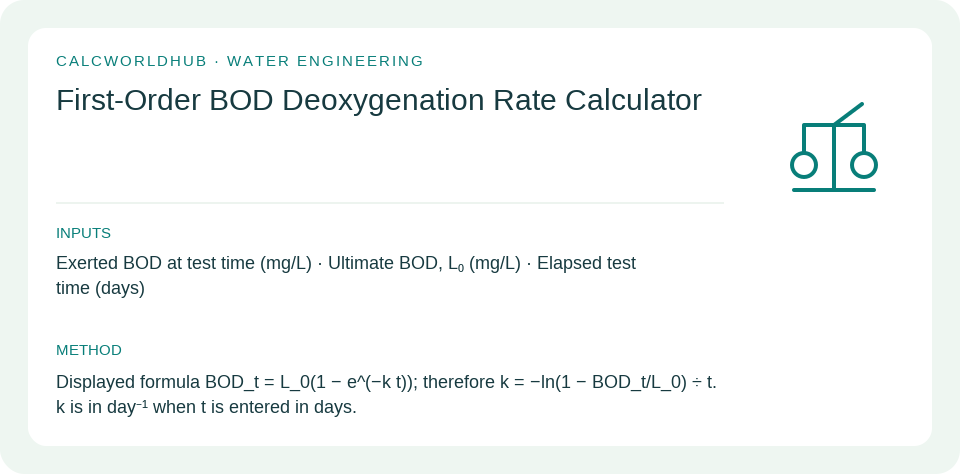
BOD_t = L_0(1 − e^(−k t)); therefore k = −ln(1 − BOD_t/L_0) ÷ t. k is in day⁻¹ when t is entered in days.
Method
The tool rearranges the first-order exertion equation. It requires exerted demand below the supplied ultimate value; as the measurement approaches the ultimate value, the inferred coefficient becomes increasingly sensitive to measurement error.
Worked example
If 190 mg/L has been exerted after 5 days and the supplied ultimate BOD is 300 mg/L, the remaining fraction is 1 − 190/300 = 0.3667. The base-e coefficient is −ln(0.3667)/5 ≈ 0.2007 day⁻¹.
Assumptions and limits
This is a single-point parameter estimate under a first-order model, not a fit to a full BOD time series. The estimate depends on sample treatment, whether the result is carbonaceous or total BOD, incubation conditions, and temperature convention. USGS describes ultimate carbonaceous BOD and a specific rate constant as parameters that may be estimated from time-series data approximating first-order kinetics.
Frequently asked questions
What does the rate coefficient represent?
Under the selected first-order model, it controls the fraction of remaining ultimate demand exerted per unit time. Its numerical value depends on the time unit and the model convention.
Why must measured BOD be below ultimate BOD?
The model defines a positive remaining demand L₀ − BOD_t. A measured value at or above L₀ makes the logarithmic estimate undefined or inconsistent with the entered model.
Is this the same as fitting a BOD curve?
No. It rearranges one point with a supplied L₀. A time-series fit estimates parameters from multiple observations and can reveal whether a first-order curve is appropriate.
Can I compare coefficients measured at different temperatures?
Only with a stated temperature convention or correction. This calculator does not apply a temperature adjustment, so compare results only on a consistent basis.
How do I use the First-Order BOD Deoxygenation Rate Calculator?
Enter Exerted BOD at test time (mg/L), Ultimate BOD, L₀ (mg/L), Elapsed test time (days). Match the units shown beside each field and review the result together with the assumptions below.
Reference: U.S. Geological Survey report on estimating ultimate carbonaceous BOD and the first-order specific rate constant. See our calculation methodology.