How to use this calculator
Approximate power and required sample size for testing zero Pearson correlation using a Fisher-z normal approximation.
- Enter True nonzero population correlation, Current independent pairs, Two-sided alpha, Target power. Match the units shown beside each field and review the result together with the assumptions below.
- Read the worked example below to check the expected input format and result.
- Compare another scenario by changing one input at a time. Use Reset to return to the starting values.
Fisher z correlation power planning explained
Approximate two-sided test power and sample size for a planned nonzero Pearson correlation using Fisher’s z transformation.
How the calculation works
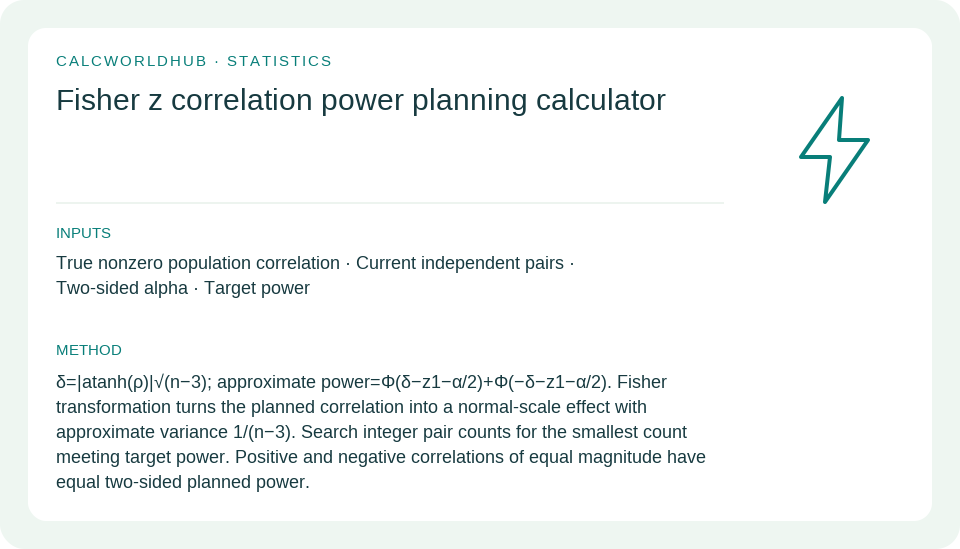
δ=|atanh(ρ)|√(n−3); approximate power=Φ(δ−z1−α/2)+Φ(−δ−z1−α/2).
Fisher transformation turns the planned correlation into a normal-scale effect with approximate variance 1/(n−3). Search integer pair counts for the smallest count meeting target power. Positive and negative correlations of equal magnitude have equal two-sided planned power.
Set up the calculation
rho— True nonzero population correlation- Nonzero planned population Pearson correlation, strictly between minus one and one.
n— Current independent pairs- Number of complete independent x,y pairs available for the correlation test. Enter a whole number.
alpha— Two-sided alpha- Prespecified two-sided test significance level, as a fraction such as 0.05.
target— Target power- Desired rejection probability under the stated planned alternative, expressed as a fraction such as 0.8.
Limits of this model
Independent bivariate-normal pairs and a nonzero planned correlation. This is an approximation, especially at small n or extreme correlations. No measurement-error, covariate-adjustment, or multiplicity allowance is included.
Check this example
True nonzero population correlation = 0.3; Current independent pairs = 80; Two-sided alpha = 0.05; Target power = 0.8.
- Fisher-z approximate correlation power: 0.77519471
- Required independent pairs: 85 pairs
With a planned correlation of 0.3 and eighty independent pairs, the transformed effect is atanh(0.3) multiplied by the square root of seventy-seven.
Reading the outputs
Required size counts complete independent pairs, not the number of scalar observations across both variables. The calculation concerns a null correlation of zero.
Frequently asked questions
Can I plan a partial correlation here?
Not directly; covariate adjustment changes effective degrees of freedom and assumptions.
Does negative rho require more data?
Not for this symmetric two-sided approximation at equal magnitude.
Why must n exceed three?
The Fisher-z variance approximation uses n−3 in its denominator.
How do I use the Fisher z correlation power planning calculator?
Enter True nonzero population correlation, Current independent pairs, Two-sided alpha, Target power. Match the units shown beside each field and review the result together with the assumptions below.
What is a worked example of Fisher z correlation power planning?
True nonzero population correlation = 0.3; Current independent pairs = 80; Two-sided alpha = 0.05; Target power = 0.8. Fisher-z approximate correlation power: 0.77519471 Required independent pairs: 85 pairs With a planned correlation of 0.3 and eighty independent pairs, the transformed effect is atanh(0.3) multiplied by the square root of seventy-seven.
Method reference: SciPy statistical function reference.