How to use this calculator
Plan equal independent group sizes or evaluate power for a two-sided normal mean test when the common population standard deviation is treated as known.
- Enter True mean difference, Known common observation SD, Current size per equal group, Two-sided alpha, then complete the remaining labeled fields. Match the units shown beside each field and review the result together with the assumptions below.
- Read the worked example below to check the expected input format and result.
- Compare another scenario by changing one input at a time. Use Reset to return to the starting values.
Known sigma two mean test power and sample size explained
For two independent equal-size groups with a common known standard deviation, the standardized mean difference shifts the normal test statistic under the planned alternative. Current power adds both rejection tails; a separate integer search finds the smallest per-group sample size meeting the target power.
Inputs, symbols, and units
d— True mean difference- Nonzero planned true mean difference in observation units. The two-sided calculation uses its absolute magnitude.
sigma— Known common observation SD- Known common population observation SD in the same unit as the planned mean difference.
n— Current size per equal group- Analyzable observations in each of two equal independent groups, not the combined total. Enter a whole number.
alpha— Two-sided alpha- Prespecified two-sided test significance level, as a fraction such as 0.05.
target— Target power- Desired rejection probability under the stated planned alternative, expressed as a fraction such as 0.8.
Formula and method
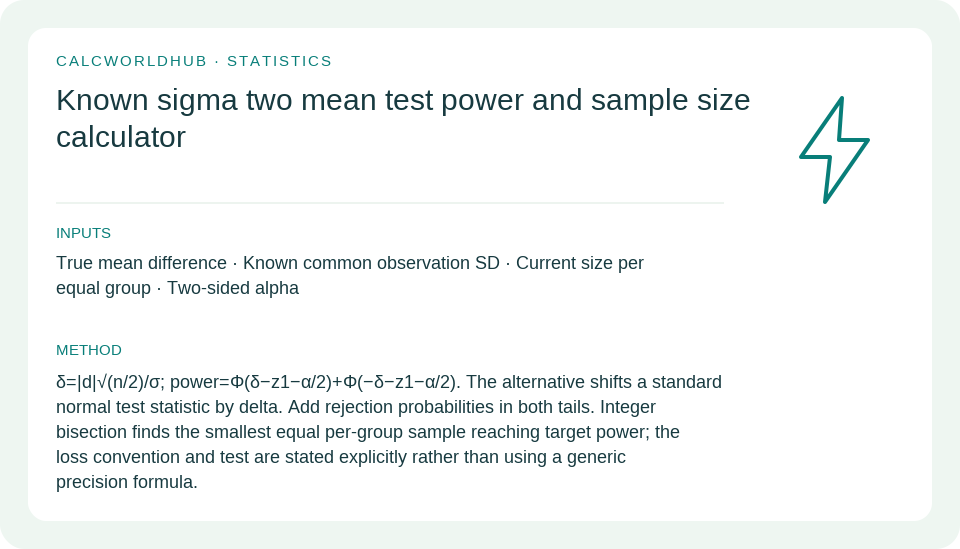
δ=|d|√(n/2)/σ; power=Φ(δ−z1−α/2)+Φ(−δ−z1−α/2).
The alternative shifts a standard normal test statistic by delta. Add rejection probabilities in both tails. Integer bisection finds the smallest equal per-group sample reaching target power; the loss convention and test are stated explicitly rather than using a generic precision formula.
A worked scenario
True mean difference = 3; Known common observation SD = 8; Current size per equal group = 60; Two-sided alpha = 0.05; Target power = 0.8.
- Two-sided known-sigma power: 0.53747353
- Required observations per equal group: 112
- Required total observations: 224
A true difference of three with SD eight gives a standardized effect of 0.375. Sixty observations per group determine current power; the separate required-size output solves for the entered target.
Assumptions and edge cases
Known common SD, independent equal groups, normal reference, nonzero specified effect. This is not an exact unknown-variance t-test calculation. Sample size excludes attrition, clustering, repeated looks, and multiple endpoints.
Reading the outputs
Current power is a probability conditional on the assumed effect and SD. The required size is per group, with a separate total to avoid allocation ambiguity.
Frequently asked questions
Is this observed post hoc power?
Use a scientifically planned effect, not a noisy observed difference, for useful planning.
Will a two-sample t-test have identical power?
Not exactly. Estimating variance changes the reference distribution.
Should I add dropout afterward?
Yes, using a justified retention assumption; this result counts analyzable observations.
How do I use the Known sigma two mean test power and sample size calculator?
Enter True mean difference, Known common observation SD, Current size per equal group, Two-sided alpha, then complete the remaining labeled fields. Match the units shown beside each field and review the result together with the assumptions below.
What is a worked example of Known sigma two mean test power and sample size?
True mean difference = 3; Known common observation SD = 8; Current size per equal group = 60; Two-sided alpha = 0.05; Target power = 0.8. Two-sided known-sigma power: 0.53747353 Required observations per equal group: 112 Required total observations: 224 A true difference of three with SD eight gives a standardized effect of 0.375. Sixty observations per group determine current power; the separate required-size output solves for the entered target.
Method reference: SciPy statistical function reference.
Read our calculation methodology.