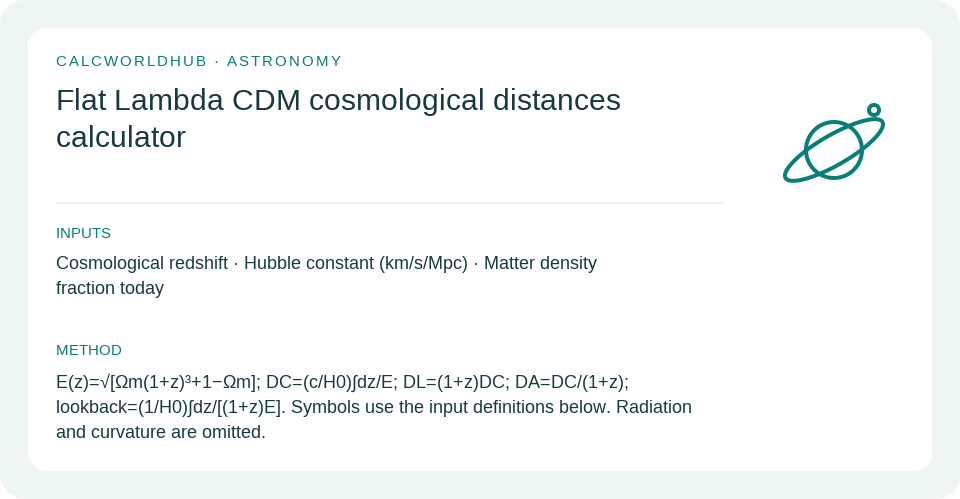
How to use this calculator
Integrate a flat matter-plus-cosmological-constant expansion model to compare comoving, luminosity, angular-diameter distance, and lookback time.
- Enter Cosmological redshift, Hubble constant (km/s/Mpc), Matter density fraction today. Match the units shown beside each field and review the result together with the assumptions below.
- Read the worked example below to check the expected input format and result.
- Compare another scenario by changing one input at a time. Use Reset to return to the starting values.
Flat Lambda CDM cosmological distances explained
This example uses a flat matter-plus-Λ cosmology to compare four standard distance and time measures.
A numerical walkthrough
Cosmological redshift = 1; Hubble constant (km/s/Mpc) = 70; Matter density fraction today = 0.3.
- Comoving radial distance: 3303.828806 Mpc
- Luminosity distance: 6607.657612 Mpc
- Angular-diameter distance: 1651.914403 Mpc
- Lookback time: 7.715337 Gyr
At redshift 1, this flat matter-plus-Λ model gives distinct comoving, luminosity, and angular-diameter distances because each measure answers a different observational question.
The model behind the numbers
E(z)=√[Ωm(1+z)³+1−Ωm]; DC=(c/H0)∫dz/E; DL=(1+z)DC; DA=DC/(1+z); lookback=(1/H0)∫dz/[(1+z)E].
Symbols use the input definitions below. Radiation and curvature are omitted.
What to enter
z— Cosmological redshift- Dimensionless redshift z sets the scale-factor change; z = 0 gives zero distance and lookback time.
h0— Hubble constant (km/s/Mpc)- Present-day expansion rate H₀ in km/s per Mpc; the distance scale varies inversely with H₀.
om— Matter density fraction today- Present matter fraction Ωm; in this flat matter-plus-Λ model, the remaining density is assigned to Λ.
Interpreting the result
Radiation and curvature are omitted. Entered parameters are assumptions, not an assertion of a current best-fit cosmology.
Verified reference: David W. Hogg, Distance measures in cosmology.
Frequently asked questions
Why are there several distances?
Brightness, angular size, and comoving separation use different cosmological measures.
Is the low-redshift Hubble law enough?
Not generally at larger redshift.
Does redshift zero give zero distance?
Yes.
How do I use the Flat Lambda CDM cosmological distances calculator?
Enter Cosmological redshift, Hubble constant (km/s/Mpc), Matter density fraction today. Match the units shown beside each field and review the result together with the assumptions below.
What is a worked example of Flat Lambda CDM cosmological distances?
Cosmological redshift = 1; Hubble constant (km/s/Mpc) = 70; Matter density fraction today = 0.3. Comoving radial distance: 3303.828806 Mpc Luminosity distance: 6607.657612 Mpc Angular-diameter distance: 1651.914403 Mpc Lookback time: 7.715337 Gyr At redshift 1, this flat matter-plus-Λ model gives distinct comoving, luminosity, and angular-diameter distances because each measure answers a different observational question.
Method reference: Astropy cosmological distance definitions.
Read our calculation methodology.