Fluid Roche limit calculator
Estimate the Roche limit for a fluid satellite around a larger primary. Enter your values below to see the result and method.
inputs.
Related calculators
These tools cover nearby questions while keeping this page focused on its own calculation.
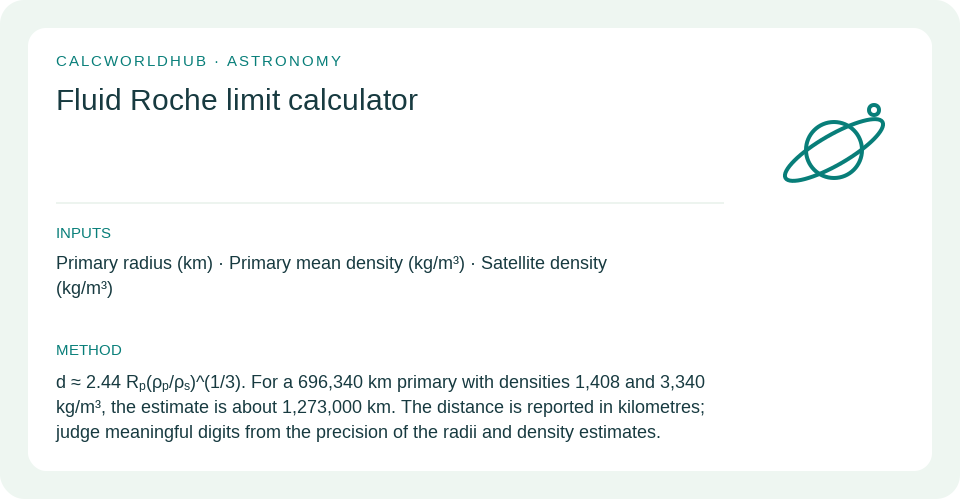
How to use this calculator
Free Fluid Roche limit calculator. Estimate the Roche limit for a fluid satellite around a larger primary. Formula, example, and assumptions explained.
- Enter Primary radius (km), Primary mean density (kg/m³), Satellite density (kg/m³). Match the units shown beside each field and review the result together with the assumptions below.
- Read the worked example below to check the expected input format and result.
- Compare another scenario by changing one input at a time. Use Reset to return to the starting values.
Set the orbit and reference body
Use this orbital-mechanics calculation to plan or interpret a two-body or approximate gravitational system. Estimate the Roche limit for a fluid satellite around a larger primary.
Inputs and units
Use the units printed beside each field. These values are Primary radius (km), Primary mean density (kg/m³), Satellite density (kg/m³).
- Primary radius (km): Primary radius as defined for the physical or engineering situation.
- Primary mean density (kg/m³): Primary mean density as defined for the physical or engineering situation.
- Satellite density (kg/m³): Satellite density as defined for the physical or engineering situation.
Orbital equation and worked example
d ≈ 2.44 Rₚ(ρₚ/ρₛ)^(1/3).
For a 696,340 km primary with densities 1,408 and 3,340 kg/m³, the estimate is about 1,273,000 km.
The distance is reported in kilometres; judge meaningful digits from the precision of the radii and density estimates.
How to interpret the orbit result
Use distances from the correct reference point and keep the gravitational parameter tied to the body named in the model. Real trajectories can include perturbations and non-spherical gravity.
Assumptions and limitations
This is the classical fluid-body estimate for an idealized circular orbit; rigidity, spin, eccentricity, and material strength change disruption conditions.
Frequently asked questions
Which values are needed for the fluid roche limit?
Enter Primary radius (km), Primary mean density (kg/m³), Satellite density (kg/m³). Check that distances and periods use the units shown beside the inputs.
Does this fluid roche limit include real-world effects?
This is the classical fluid-body estimate for an idealized circular orbit; rigidity, spin, eccentricity, and material strength change disruption conditions.
When is primary-body density the main quantity?
Use a density calculation when you only need mass per volume. The fluid Roche estimate combines primary radius and density with satellite density to approximate a tidal-disruption distance.
How do I use the Fluid Roche limit calculator?
Enter Primary radius (km), Primary mean density (kg/m³), Satellite density (kg/m³). Match the units shown beside each field and review the result together with the assumptions below.
What is a worked example of Fluid Roche limit?
d ≈ 2.44 Rₚ(ρₚ/ρₛ)^(1/3). For a 696,340 km primary with densities 1,408 and 3,340 kg/m³, the estimate is about 1,273,000 km. The distance is reported in kilometres; judge meaningful digits from the precision of the radii and density estimates.
Read the calculation methodology and privacy policy.
Method source: NASA technical report, fluid Roche-limit density relation.