Planet mean density calculator
Calculate a spherical body’s mean density from mass and radius. Enter your values below to see the result and method.
inputs.
Related calculators
Compare bulk density with surface gravity and escape speed to describe different physical properties of the same body.
How to use this calculator
Free Planet mean density calculator. Calculate a spherical body’s mean density from mass and radius. Formula, example, and assumptions explained.
- Enter Mass (kg), Mean radius (m). Match the units shown beside each field and review the result together with the assumptions below.
- Read the worked example below to check the expected input format and result.
- Compare another scenario by changing one input at a time. Use Reset to return to the starting values.
Relate mass to spherical volume
The mean density is total mass divided by the volume of a sphere with the entered mean radius. Calculate a spherical body’s mean density from mass and radius.
Inputs and units
Enter total body mass in kilograms and mean radius in meters; the result is average mass per spherical volume.
- Mass (kg): Total mass of the body whose mean density is being estimated.
- Mean radius (m): Radius used for the spherical-volume model; the result is bulk average density, not local density.
Density equation and worked example
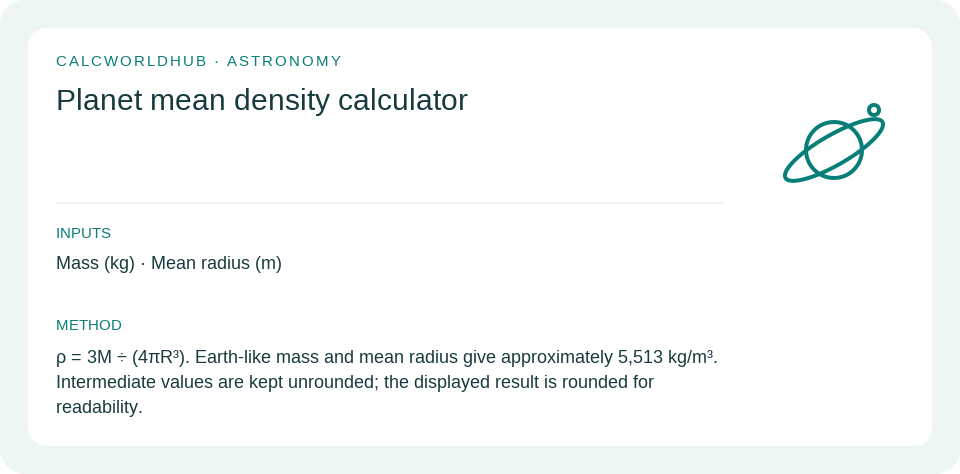
ρ = 3M ÷ (4πR³).
Earth-like mass and mean radius give approximately 5,513 kg/m³.
Intermediate values are kept unrounded; the displayed result is rounded for readability.
Interpreting bulk density
This is the body’s bulk average density under a spherical-volume assumption, not a local atmospheric, surface, or core density.
Assumptions and limitations
Assumes a sphere and bulk mass; this is mean density, not surface or atmospheric density.
Frequently asked questions
How is a planet’s mean density estimated?
Divide the total mass by the assumed spherical volume, 4πR³/3. This is a bulk average, not the density of the surface or core.
Which radius belongs in the calculation?
Use the mean radius in the same length unit as the mass and keep units consistent. Oblateness can make equatorial and polar radii differ.
Why may the result differ from a published Earth density?
The entered mass and mean radius determine the result. Published values use specified reference data and rounding; the calculator does not substitute them.
How do I use the Planet mean density calculator?
Enter Mass (kg), Mean radius (m). Match the units shown beside each field and review the result together with the assumptions below.
What is a worked example of Planet mean density?
ρ = 3M ÷ (4πR³). Earth-like mass and mean radius give approximately 5,513 kg/m³. Intermediate values are kept unrounded; the displayed result is rounded for readability.
Read the calculation methodology and privacy policy.