Planet surface gravity calculator
Estimate surface gravitational acceleration from a planet’s mass and mean radius. Enter your values below to see the result and method.
inputs.
Related calculators
Bulk density and escape speed add context to a spherical-body surface-gravity estimate.
How to use this calculator
Estimate surface gravitational acceleration from a planet’s mass and mean radius.
- Enter Planet mass (kg), Mean radius (m). Match the units shown beside each field and review the result together with the assumptions below.
- Read the worked example below to check the expected input format and result.
- Compare another scenario by changing one input at a time. Use Reset to return to the starting values.
Estimate gravity at the mean surface
For a spherical, nonrotating body, surface gravity follows GM/R²; this model excludes rotation and local terrain. Estimate surface gravitational acceleration from a planet’s mass and mean radius.
Inputs and units
Enter the body’s total mass in kilograms and mean radius in meters; both values describe the same body.
- Planet mass (kg): Total mass M of the body, in kilograms.
- Mean radius (m): Distance from the body's center to the mean surface, in meters.
Surface-gravity equation and worked example
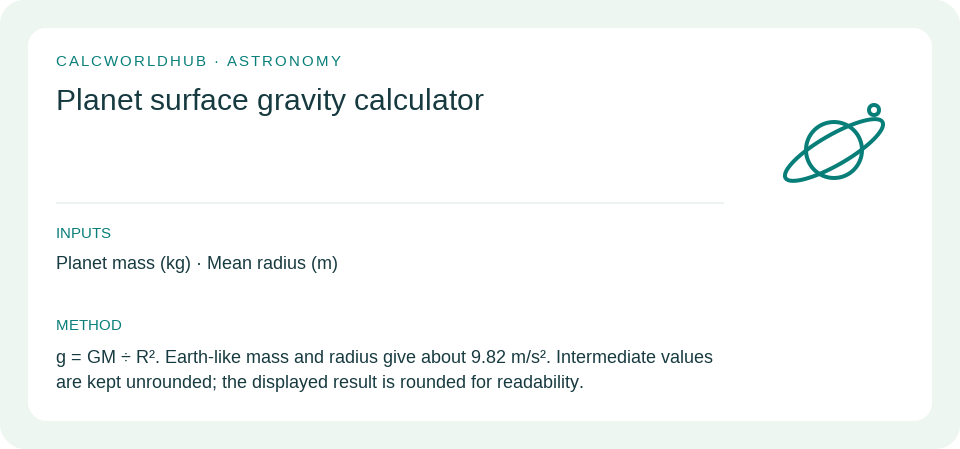
g = GM ÷ R².
Earth-like mass and radius give about 9.82 m/s².
Intermediate values are kept unrounded; the displayed result is rounded for readability.
Interpreting surface gravity
The result is ideal gravitational acceleration at the specified mean radius, excluding rotation, topography, and local mass variation.
Assumptions and limitations
Uses mean radius and a spherical point-mass approximation; rotation and local topography are excluded.
Frequently asked questions
How is surface gravity calculated?
For a spherical body treated as a point mass outside it, g=GM/R² using the body’s mass M and mean radius R.
Is this the gravity a person would feel at every location?
No. The result omits rotation, latitude, altitude, local mass variations, and topography; it is a spherical-body estimate.
Why does the output have acceleration units?
G×mass/radius² reduces to m/s² when SI units are used, which is gravitational acceleration rather than force.
How do I use the Planet surface gravity calculator?
Enter Planet mass (kg), Mean radius (m). Match the units shown beside each field and review the result together with the assumptions below.
What is a worked example of Planet surface gravity?
g = GM ÷ R². Earth-like mass and radius give about 9.82 m/s². Intermediate values are kept unrounded; the displayed result is rounded for readability.
Read the calculation methodology and privacy policy.