FMEA risk priority number calculator
Multiply the three documented FMEA ratings to obtain a traditional RPN score.
inputs.
Calculator
How to use this calculator
Calculate the traditional FMEA risk priority number by multiplying severity, occurrence, and detection ratings.
- Enter Severity rating (1–10), Occurrence rating (1–10), Detection rating (1–10). Match the units shown beside each field and review the result together with the assumptions below.
- Read the worked example below to check the expected input format and result.
- Compare another scenario by changing one input at a time. Use Reset to return to the starting values.
Multiply three FMEA ratings to obtain a traditional RPN
The traditional risk priority number combines severity, occurrence, and detection ratings for one failure mode. It produces a score from the selected scales; the score is a prioritization aid, not a probability of failure.
Inputs and units
- Severity rating (1–10): The severity score assigned using the organization’s documented FMEA scale.
- Occurrence rating (1–10): The occurrence score assigned using that same FMEA method.
- Detection rating (1–10): The detection score assigned using the method’s criteria; higher ratings commonly indicate a harder-to-detect failure.
Formula and method
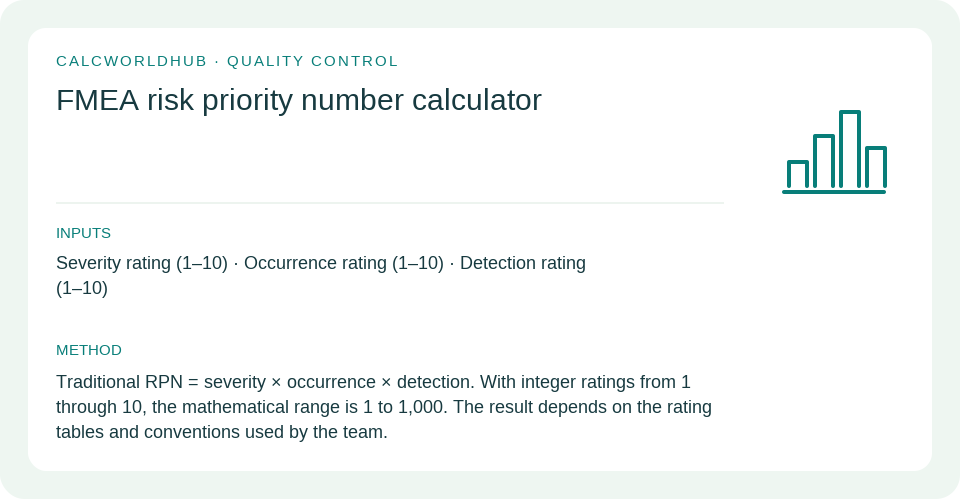
Traditional RPN = severity × occurrence × detection. With integer ratings from 1 through 10, the mathematical range is 1 to 1,000. The result depends on the rating tables and conventions used by the team.
Worked example
For severity 8, occurrence 4, and detection 3, RPN = 8 × 4 × 3 = 96. This is the product of the three entered ratings, not a 96% risk or a forecast of 96 failures.
Interpreting the result
Use the score alongside the three component ratings and the failure-mode evidence. Different rating combinations can produce the same product, so the RPN alone can conceal a severe issue or a weak detection control.
Assumptions and limits
Document which FMEA rating scales are being used and do not apply universal action thresholds to this product. AIAG and VDA’s harmonized method includes Action Priority tables; organizations should follow their adopted standard and customer requirements rather than treating traditional RPN as the only prioritization rule.
Method references
Frequently asked questions
Does a lower RPN always mean a safer failure mode?
Not necessarily. The product can hide a high severity rating when other ratings are lower, and different combinations can share the same RPN. Review each rating and the applicable action-priority method.
How do I use the FMEA risk priority number calculator?
Enter Severity rating (1–10), Occurrence rating (1–10), Detection rating (1–10). Match the units shown beside each field and review the result together with the assumptions below.
What is a worked example of FMEA risk priority number?
For severity 8, occurrence 4, and detection 3, RPN = 8 × 4 × 3 = 96. This is the product of the three entered ratings, not a 96% risk or a forecast of 96 failures.
What does the FMEA risk priority number calculator calculate?
Calculate the traditional FMEA risk priority number by multiplying severity, occurrence, and detection ratings.
What assumptions apply to FMEA risk priority number?
Document which FMEA rating scales are being used and do not apply universal action thresholds to this product. AIAG and VDA’s harmonized method includes Action Priority tables; organizations should follow their adopted standard and customer requirements rather than treating traditional RPN as the only prioritization rule.
Good calculators show their work.
CalcWorldHub is built around clear inputs and visible assumptions. Results are estimates for planning; check official sources or your provider’s terms when exact figures matter.