
What question does this metric answer?
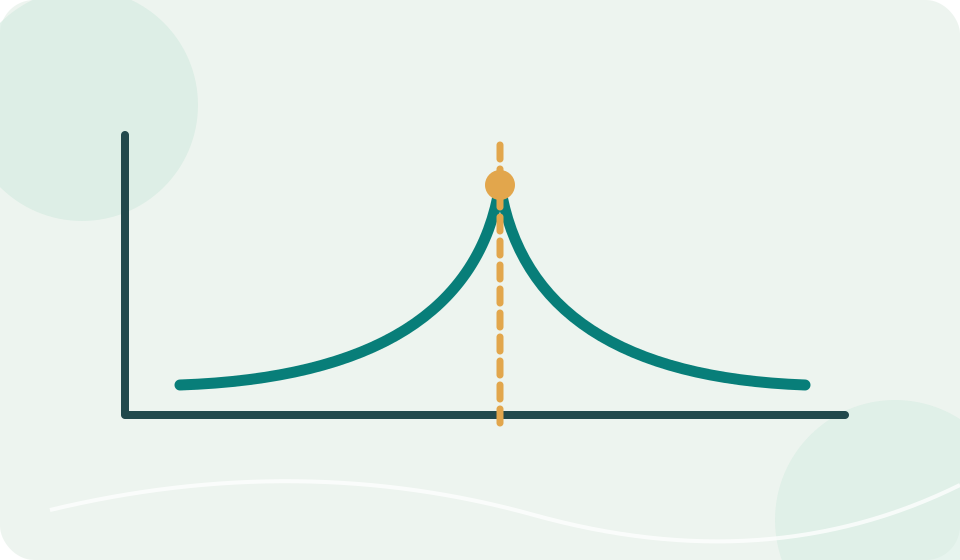
The Taguchi loss function treats deviation from a target as a gradual cost, even while a measurement remains within specification. This differs from a simple pass/fail view in which loss is zero inside the tolerance band and appears only after a boundary is crossed.
The calculator uses a nominal-the-best quadratic model. A measured characteristic can be above or below target; the squared deviation assigns the same modeled loss at equal distances on both sides, so it cannot represent asymmetric customer penalties without a different model.
Define the numerator and denominator
Enter a measured value, target, positive target-to-boundary deviation, nonnegative loss at that boundary, and batch quantity. The first four characteristic values use one common unit; the boundary loss is currency per item, and quantity is a whole number of comparable units.
The tolerance deviation is the distance from target to either symmetric boundary, not the full upper-to-lower tolerance width. If a specification is 9.8 to 10.2 around target 10, the deviation is 0.2 rather than 0.4.
The coefficient carries units of currency per squared measurement unit: for a measurement in millimetres, k is currency per mm². If the characteristic is converted to another unit, convert the tolerance deviation and measured offset together; otherwise the numerical loss changes by the square of the conversion factor.
Formula and worked example
The loss coefficient is k=A/Δ², where A is the selected loss at the boundary and Δ is its deviation from target. Per-item loss is k times squared error; batch loss multiplies that estimate by quantity.
If target is 10, measured value 10.1, Δ=0.2, and boundary loss is $100, k=100/0.2²=$2,500 per unit squared. Per-item loss is $2,500×0.1²=$25; a batch of 50 gives $1,250.

Interpret the result in context
If measured value is 9.7, target 10, Δ=0.5, boundary loss $400, and quantity 20, k=400/0.25=$1,600. The deviation magnitude is 0.3, so per-item loss is $144 and batch loss is $2,880.
The display rounds per-item and batch loss to two currency decimals. The model output is an estimate tied to the boundary-loss assumption, not a measured invoice, warranty reserve, or market-price calculation.
Assumptions and boundaries
Because deviation is squared, doubling the distance from target quadruples modeled per-item loss under the same coefficient. This sensitivity can help compare process centering, but the result depends strongly on the chosen target, boundary, and assigned loss amount.
The nominal-the-best equation assumes a symmetric target and an appropriate quadratic approximation. Use a one-sided or asymmetric model when only one direction matters or the costs differ materially above and below target.
Make the calculation reproducible
This calculator does not test whether the characteristic follows a distribution, estimate average loss from a batch of variable measurements, determine specifications, or calculate capability. Entering one reading summarizes one characteristic value under the chosen model.
Keep the target source, tolerance convention, boundary-loss rationale, currency, and batch size with each estimate. the Taguchi loss calculator evaluates the equation; engineering and business owners must validate the assumed loss curve.
Worked examples
The examples use the same symmetric squared-deviation model but different target offsets and boundary assumptions. Follow the sign through the calculation, then square the deviation to obtain the modeled loss.
A small offset inside a symmetric tolerance
Inputs: Measured 10.1; target 10; deviation to boundary 0.2; boundary loss $100; quantity 50
Calculation: k=100/0.2²=2,500; per-item=2,500×0.1²=$25; batch=25×50=$1,250
The model estimates $25 per item and $1,250 for 50 comparable units, despite the measured value remaining within the assumed boundary.
A larger offset with a wider tolerance
Inputs: Measured 9.7; target 10; deviation to boundary 0.5; boundary loss $400; quantity 20
Calculation: k=400/0.5²=1,600; per-item=1,600×(−0.3)²=$144; batch=144×20=$2,880
The symmetric squared-error model assigns $144 per item and $2,880 across 20 units.