Forecast directional accuracy calculator
Compare forecasted and observed directions of change using the prior observed value as the baseline.
How to use this calculator
Compare forecasted and observed directions of change using the prior observed value as the baseline.
- Enter Actual series, chronological, Forecasts for periods 2…n. Match the units shown beside each field and review the result together with the assumptions below.
- Read the worked example below to check the expected input format and result.
- Compare another scenario by changing one input at a time. Use Reset to return to the starting values.
How the Forecast directional accuracy calculator works
Compare forecasted and observed directions of change using the prior observed value as the baseline.
Inputs and units
- Actual series, chronological: Actual series is chronological and contains n observed values; consecutive observations define the reference direction.
- Forecasts for periods 2…n: Forecast list contains one prediction for each actual period from 2 through n, paired in order.
Formula and method
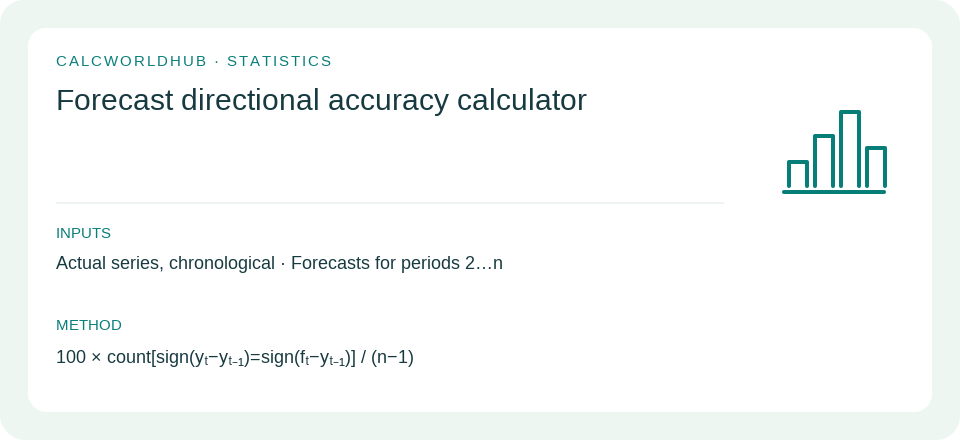
100 × count[sign(yₜ−yₜ₋₁)=sign(fₜ−yₜ₋₁)] / (n−1)
Worked example
Actuals 10, 12, 9, 11 and forecasts 11, 11, 9 give two matching directions out of three, or 66.67%.
Interpreting the result
This percentage measures whether the forecast moved in the same direction as the next actual. When both changes are exactly zero, the tie counts as a match.
Assumptions and limits
Forecasts align to actual periods 2 through n. Directional accuracy ignores error size and does not establish that a forecast is well calibrated or profitable.
Frequently asked questions
Can directional accuracy be high when forecasts are far off?
Yes. The score checks change direction only and ignores error magnitude.
How are unchanged periods treated?
A zero actual change matches only a forecast equal to the previous actual, which also predicts no change.
How do I use the Forecast directional accuracy calculator?
Enter Actual series, chronological, Forecasts for periods 2…n. Match the units shown beside each field and review the result together with the assumptions below.
What is a worked example of Forecast directional accuracy?
Actuals 10, 12, 9, 11 and forecasts 11, 11, 9 give two matching directions out of three, or 66.67%.
What does the Forecast directional accuracy calculator calculate?
Compare forecasted and observed directions of change using the prior observed value as the baseline.
See the calculation methodology.