Mean absolute scaled error calculator
Evaluate an in-sample, nonseasonal training diagnostic: compare one-step fitted-value MAE with the naive change scale of the same training series.
How to use this calculator
Evaluate an in-sample, nonseasonal training diagnostic: compare one-step fitted-value MAE with the naive change scale of the same training series.
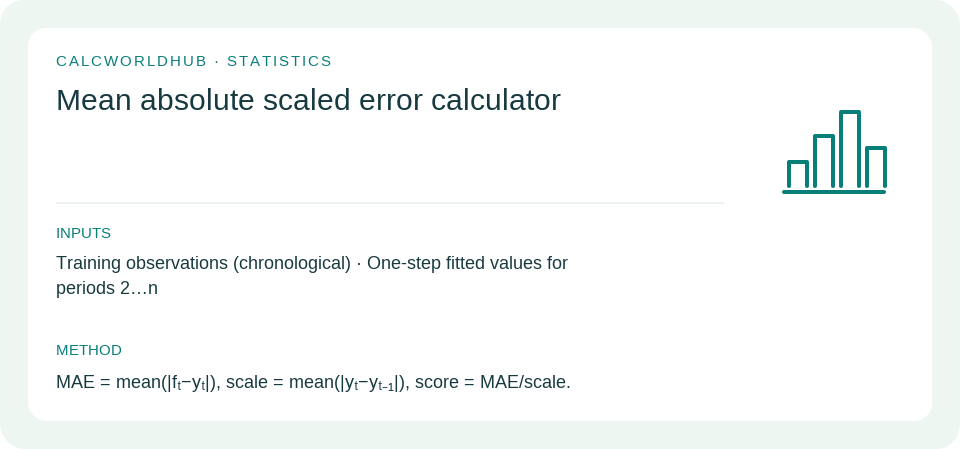
- Enter Training observations (chronological), One-step fitted values for periods 2…n. Match the units shown beside each field and review the result together with the assumptions below.
- Read the worked example below to check the expected input format and result.
- Compare another scenario by changing one input at a time. Use Reset to return to the starting values.
How the Mean absolute scaled error calculator works
Evaluate an in-sample, nonseasonal training diagnostic: compare one-step fitted-value MAE with the naive change scale of the same training series.
Inputs and units
- Training observations (chronological): Enter at least two chronological training observations. The first observation contributes to the naive change scale.
- One-step fitted values for periods 2…n: Enter one-step fitted values aligned with training periods 2 through n. Use the same response units as the observations.
Formula and method
MAE = mean(|fₜ−yₜ|), scale = mean(|yₜ−yₜ₋₁|), score = MAE/scale.
Worked example
Actuals 10,12,15,18 and forecasts 11,14,17 have MAE=1 and same-series naive scale=8/3, so the score is 0.375.
Interpreting the result
Below 1 means the forecast errors are smaller than this entered series’ one-step change scale. The runtime uses the same series for both terms.
Assumptions and limits
This is an in-sample, nonseasonal scaled-error diagnostic. It has no separate held-out test series, seasonal lag, or multi-step evaluation. A constant training series has zero naive scale and an undefined ratio.
Sources and method
- Defines scaling by naive training-data errors. This page uses that denominator with one-step fitted errors on the same training periods, so it reports the in-sample diagnostic. Hyndman & Koehler (2006), Another look at measures of forecast accuracy
Frequently asked questions
Is this standard out-of-sample MASE?
No. Both the fitted errors and the naive denominator use the entered training series. There is no held-out test-series input.
What happens when the series is constant?
Its mean absolute one-step change is zero, so the scaled ratio is undefined.
How do I use the Mean absolute scaled error calculator?
Enter Training observations (chronological), One-step fitted values for periods 2…n. Match the units shown beside each field and review the result together with the assumptions below.
What is a worked example of Mean absolute scaled error?
Actuals 10,12,15,18 and forecasts 11,14,17 have MAE=1 and same-series naive scale=8/3, so the score is 0.375.
What does the Mean absolute scaled error calculator calculate?
Evaluate an in-sample, nonseasonal training diagnostic: compare one-step fitted-value MAE with the naive change scale of the same training series.
See the calculation methodology.