How to use this calculator
Compare group selection rates and compute the lowest rate as a percentage of the highest rate.
- Enter Applicants per group (same order), Selected per group (same order). Match the units shown beside each field and review the result together with the assumptions below.
- Read the worked example below to check the expected input format and result.
- Compare another scenario by changing one input at a time. Use Reset to return to the starting values.
How this calculation works
This screening calculator compares selection rates across two or more applicant groups. Enter applicant counts and selected counts in matching order. It computes each group's rate, identifies the highest and lowest rates, and compares the lowest rate with the four-fifths (80%) guideline described in the Uniform Guidelines on Employee Selection Procedures.
Inputs and units
applicants— Applicants per group (same order)- Enter 2–20 whole-number applicant counts, comma or space separated; no group may have zero applicants.
selected— Selected per group (same order)- Enter one whole-number selected count for each applicant count, in exactly the same group order.
Formula
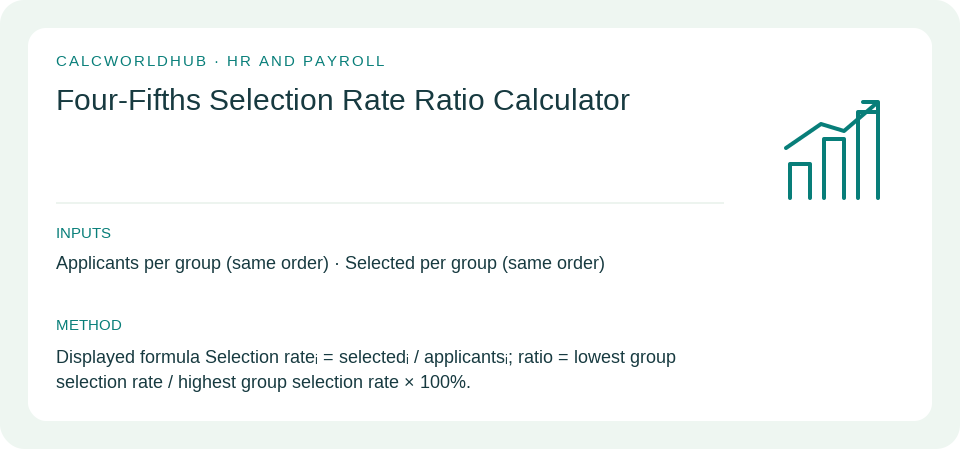
Selection rateᵢ = selectedᵢ / applicantsᵢ; ratio = lowest group selection rate / highest group selection rate × 100%.
Method
For each group, divide the number selected by the number of applicants. Divide the lowest group rate by the highest group rate and express the result as a percentage. A value below 80% is flagged as below the four-fifths screen.
Worked example
For applicant counts 100, 80, and 50 with 60, 40, and 15 selected, the selection rates are 60%, 50%, and 30%. The lowest-to-highest ratio is 50%, below the 80% screen.
Assumptions and limits
This is only a numerical screen, not a legal determination. The Uniform Guidelines note that smaller or larger differences may matter depending on statistical and practical significance, sample size, process details, and other evidence. Enter comparable applicant pools and keep group order aligned between both lists.
Frequently asked questions
What does a ratio below 80% mean?
It is a screen that may indicate adverse impact under the Uniform Guidelines; it does not by itself settle a legal question.
Why compare every group with the highest rate?
The four-fifths guideline compares a group's selection rate with the rate of the group with the highest selection rate.
Can this result be used with a very small sample?
The arithmetic still works, but small samples can make rates unstable. The guidelines discuss sample size and other evidence, so review the full context.
How do I use the Four-Fifths Selection Rate Ratio Calculator?
Enter Applicants per group (same order), Selected per group (same order). Match the units shown beside each field and review the result together with the assumptions below.
What is a worked example of Four-Fifths Selection Rate Ratio?
For applicant counts 100, 80, and 50 with 60, 40, and 15 selected, the selection rates are 60%, 50%, and 30%. The lowest-to-highest ratio is 50%, below the 80% screen.
Reference: technical reference. See our calculation methodology.