How to use this calculator
Estimate a binary polymer blend glass-transition temperature from component Tg values and weight fraction.
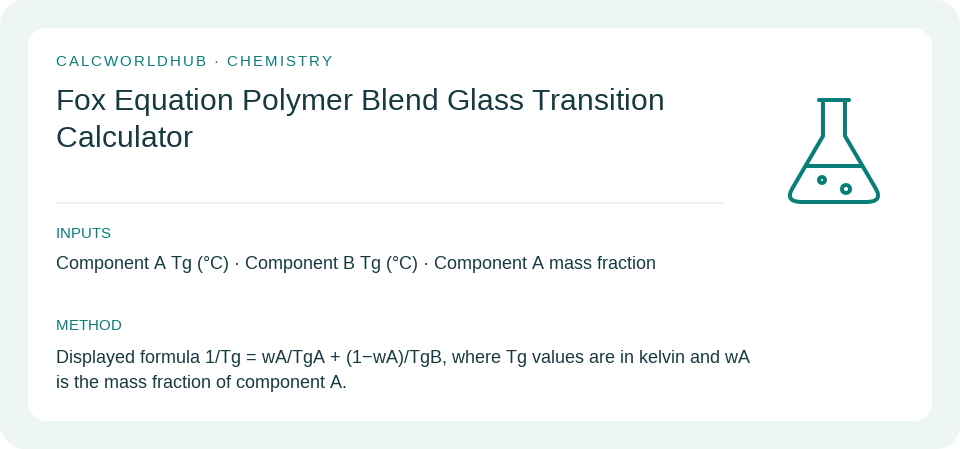
- Enter Component A Tg (°C), Component B Tg (°C), Component A mass fraction. Match the units shown beside each field and review the result together with the assumptions below.
- Read the worked example below to check the expected input format and result.
- Compare another scenario by changing one input at a time. Use Reset to return to the starting values.
How this calculation works
The Fox equation estimates the glass-transition temperature of a binary mixture by taking the weight-fraction average of the inverse absolute component temperatures. Component temperatures must be converted to kelvin before the reciprocal average is evaluated.
Inputs and units
tgAC— Component A Tg (°C)- Glass-transition temperature of polymer A in degrees Celsius.
tgBC— Component B Tg (°C)- Glass-transition temperature of polymer B in degrees Celsius.
weightFractionA— Component A mass fraction- Mass fraction of component A in the blend, from 0 to 1.
Formula
1/Tg = wA/TgA + (1−wA)/TgB, where Tg values are in kelvin and wA is the mass fraction of component A.
Method
Enter the two component glass-transition temperatures in °C and the mass fraction of component A from 0 to 1. The calculator converts each Tg to kelvin, applies the Fox equation, and converts the blend estimate back to °C.
Worked example
A 50/50 mass blend with component Tg values of 100 °C and 120 °C gives a Fox-equation estimate of about 109.74 °C.
Assumptions and limits
This is an empirical estimate most appropriate for compatible or miscible amorphous binary blends with no dominant specific interaction. Real blends may phase-separate, have multiple transitions, or fit another model better; use measured data and a suitable polymer-specific model for design decisions.
Frequently asked questions
Why are temperatures converted to kelvin?
The equation averages reciprocal absolute temperatures, so Celsius values cannot be used directly.
Does this predict whether polymers are miscible?
No. The equation estimates Tg under a compatible-blend assumption but does not establish miscibility.
Can the predicted Tg differ from measurements?
Yes. Specific interactions, morphology, phase separation, and other effects can shift measured transitions.
How do I use the Fox Equation Polymer Blend Glass Transition Calculator?
Enter Component A Tg (°C), Component B Tg (°C), Component A mass fraction. Match the units shown beside each field and review the result together with the assumptions below.
What is a worked example of Fox Equation Polymer Blend Glass Transition?
A 50/50 mass blend with component Tg values of 100 °C and 120 °C gives a Fox-equation estimate of about 109.74 °C.
Reference: Binary polymer-blend study reporting the Fox equation for glass-transition estimates. See our calculation methodology.