Linear thermal expansion calculator
Use a coefficient and original length for the same material and the temperature interval of interest. A negative temperature change predicts contraction for a positive coefficient.
Calculator
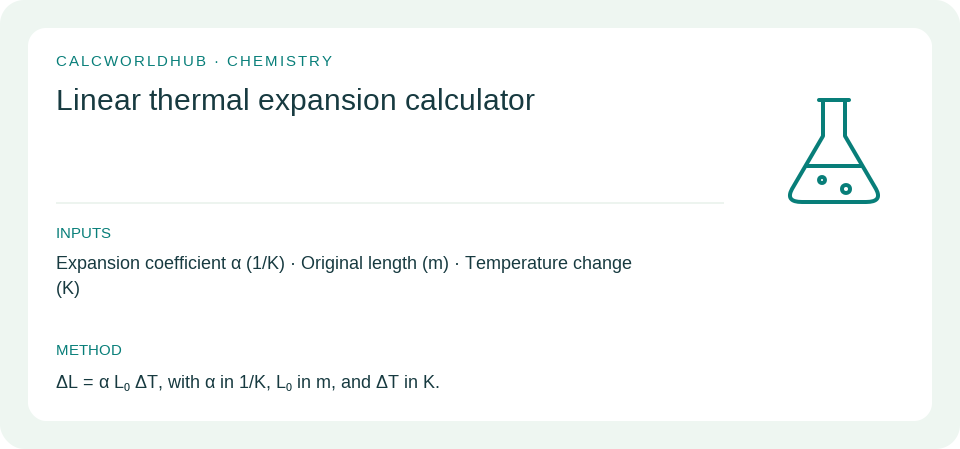
How to use this calculator
Estimate a solid’s length change from its expansion coefficient, original length, and signed temperature change.
- Enter Expansion coefficient α (1/K), Original length (m), Temperature change (K). Match the units shown beside each field and review the result together with the assumptions below.
- Read the worked example below to check the expected input format and result.
- Compare another scenario by changing one input at a time. Use Reset to return to the starting values.
Linear thermal expansion calculator
Use a coefficient and original length for the same material and the temperature interval of interest. A negative temperature change predicts contraction for a positive coefficient.
What it measures
The linear model estimates dimensional change along one direction; it does not predict stress or constrained expansion.
Inputs and units
- Expansion coefficient α (1/K): Linear expansion coefficient α in inverse kelvin for the material and interval.
- Original length (m): Positive original length L₀ in meters.
- Temperature change (K): Signed final-minus-initial temperature change in kelvin.
Formula and method
ΔL = α L₀ ΔT, with α in 1/K, L₀ in m, and ΔT in K.
Worked example
For α = 1.2×10⁻⁵ K⁻¹, L₀ = 2 m, and ΔT = 80 K, ΔL = 0.00192 m = 1.92 mm.
Interpreting the result
Positive ΔL means length increases; negative ΔL means it contracts. A temperature difference of one kelvin has the same size as one Celsius degree.
Assumptions and limits
The formula assumes a constant coefficient over the interval and small, uniform temperature change. Material restraint can create stress; this page estimates free expansion only.
Sources and method
- Gives ΔL=αL₀ΔT and notes that expansion coefficients vary somewhat with temperature. OpenStax College Physics 2e: Thermal expansion
Frequently asked questions
Can temperature change be negative?
Yes. A negative ΔT represents cooling and reverses the sign for a positive coefficient.
Does this calculate thermal stress?
No. It estimates free length change; constrained expansion requires a stress model.
How do I use the Linear thermal expansion calculator?
Enter Expansion coefficient α (1/K), Original length (m), Temperature change (K). Match the units shown beside each field and review the result together with the assumptions below.
What is a worked example of Linear thermal expansion?
For α = 1.2×10⁻⁵ K⁻¹, L₀ = 2 m, and ΔT = 80 K, ΔL = 0.00192 m = 1.92 mm.
What does the Linear thermal expansion calculator calculate?
Estimate a solid’s length change from its expansion coefficient, original length, and signed temperature change.
See the calculation methodology.
Good calculators show their work.
CalcWorldHub is built around clear inputs and visible assumptions. Results are estimates for planning; check official sources or your provider’s terms when exact figures matter.