Plane wall conduction rate calculator
Enter the hot-side and cold-side surface temperatures, wall area, thickness, and material conductivity. The signed result follows hot minus cold.
Calculator
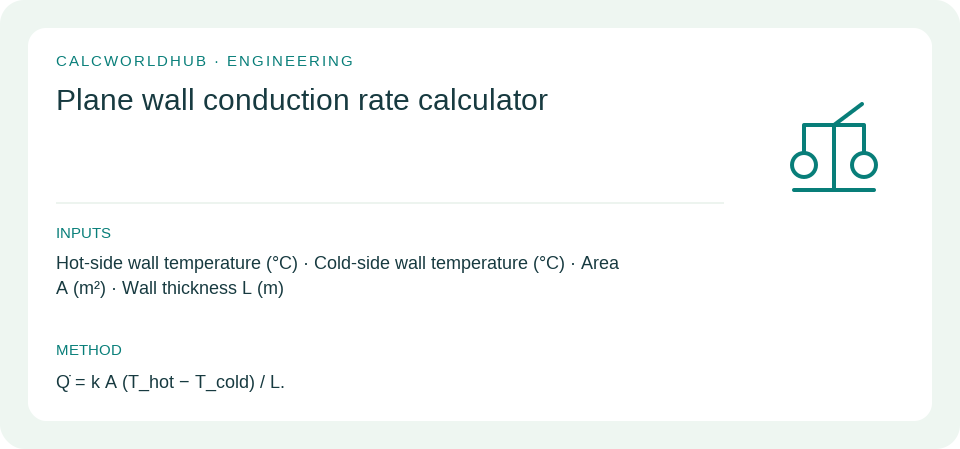
How to use this calculator
Estimate steady one-dimensional heat conduction through a uniform plane wall from conductivity, area, thickness, and side temperatures.
- Enter Hot-side wall temperature (°C), Cold-side wall temperature (°C), Area A (m²), Wall thickness L (m), then complete the remaining labeled fields. Match the units shown beside each field and review the result together with the assumptions below.
- Read the worked example below to check the expected input format and result.
- Compare another scenario by changing one input at a time. Use Reset to return to the starting values.
Plane wall conduction rate calculator
Enter the hot-side and cold-side surface temperatures, wall area, thickness, and material conductivity. The signed result follows hot minus cold.
What it measures
This is the plane-wall form of Fourier conduction for a uniform slab in steady state. The output is a heat-transfer rate in watts.
Inputs and units
- Hot-side wall temperature (°C): Temperature at the hot-side wall surface in °C.
- Cold-side wall temperature (°C): Temperature at the cold-side wall surface in °C.
- Area A (m²): Wall conduction area A in m².
- Wall thickness L (m): Positive wall thickness L in meters.
- Wall conductivity k (W/m·K): Positive thermal conductivity k in W/(m·K).
Formula and method
Q̇ = k A (T_hot − T_cold) / L.
Worked example
For k=0.8 W/(m·K), A=3 m², L=0.05 m, T_hot=50°C, and T_cold=30°C, Q̇=0.8×3×20/0.05=960 W.
Interpreting the result
A positive result means heat flows from the entered hot side toward the cold side under the sign convention. Temperature differences in °C and K have the same magnitude.
Assumptions and limits
Assumes steady, one-dimensional conduction, uniform k and thickness, and no contact or surface-film resistance. Density and specific heat affect transient storage, not this steady rate; they were removed from the visible inputs because they do not affect this formula.
Sources and method
- Explains steady conduction through a slab and the effects of conductivity, area, temperature difference, and thickness. OpenStax College Physics 2e: Conduction
Frequently asked questions
Why are density and specific heat not inputs?
They govern transient heat storage; the steady slab rate uses conductivity, area, thickness, and temperature difference.
Can the calculated heat rate be negative?
Yes. If the entered cold-side temperature exceeds the hot-side temperature, the sign reverses.
How do I use the Plane wall conduction rate calculator?
Enter Hot-side wall temperature (°C), Cold-side wall temperature (°C), Area A (m²), Wall thickness L (m), then complete the remaining labeled fields. Match the units shown beside each field and review the result together with the assumptions below.
What is a worked example of Plane wall conduction rate?
For k=0.8 W/(m·K), A=3 m², L=0.05 m, T_hot=50°C, and T_cold=30°C, Q̇=0.8×3×20/0.05=960 W.
What does the Plane wall conduction rate calculator calculate?
Estimate steady one-dimensional heat conduction through a uniform plane wall from conductivity, area, thickness, and side temperatures.
See the calculation methodology.
Good calculators show their work.
CalcWorldHub is built around clear inputs and visible assumptions. Results are estimates for planning; check official sources or your provider’s terms when exact figures matter.