Heat exchanger transfer rate calculator
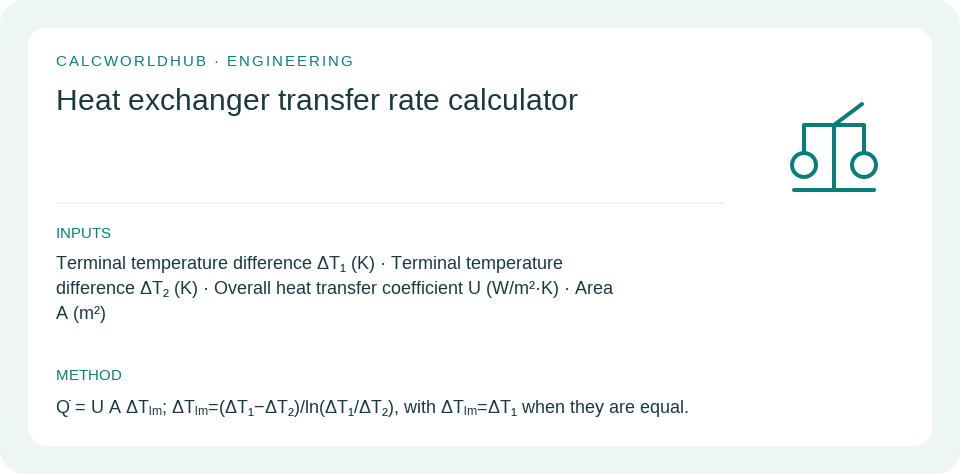
Enter the two positive end temperature differences, overall heat-transfer coefficient, and heat-transfer area in consistent SI units.
Calculator
How to use this calculator
Estimate steady heat-transfer rate from overall coefficient, area, and logarithmic mean terminal temperature difference.
- Enter Terminal temperature difference ΔT₁ (K), Terminal temperature difference ΔT₂ (K), Overall heat transfer coefficient U (W/m²·K), Area A (m²). Match the units shown beside each field and review the result together with the assumptions below.
- Read the worked example below to check the expected input format and result.
- Compare another scenario by changing one input at a time. Use Reset to return to the starting values.
Heat exchanger transfer rate calculator
Enter the two positive end temperature differences, overall heat-transfer coefficient, and heat-transfer area in consistent SI units.
What it measures
The log-mean temperature difference compresses the changing temperature driving force along an exchanger into one mean value for the idealized heat-rate relation.
Inputs and units
- Terminal temperature difference ΔT₁ (K): Positive temperature difference between the hot and cold streams at one exchanger end, in kelvin.
- Terminal temperature difference ΔT₂ (K): Positive end temperature difference at the other end, in kelvin.
- Overall heat transfer coefficient U (W/m²·K): Overall heat-transfer coefficient U in W/(m²·K).
- Area A (m²): Heat-transfer area A in m².
Formula and method
Q̇ = U A ΔTₗₘ; ΔTₗₘ=(ΔT₁−ΔT₂)/ln(ΔT₁/ΔT₂), with ΔTₗₘ=ΔT₁ when they are equal.
Worked example
For ΔT₁=50 K, ΔT₂=30 K, U=250 W/(m²·K), and A=3 m², ΔTₗₘ≈39.152 K and Q̇≈29,364.23 W.
Interpreting the result
A positive result is a heat-rate magnitude under the entered convention. The LMTD is between the two positive end differences and is not their arithmetic mean.
Assumptions and limits
The estimate assumes steady operation and a suitable pairing of end differences. It treats U as constant and does not add a correction factor for crossflow or complex multi-pass geometry.
Sources and method
- Defines logarithmic mean temperature difference from positive end temperature differences and uses it in exchanger heat-transfer calculations. MIT Unified Engineering: Heat exchangers
Frequently asked questions
What if the two end differences are equal?
The logarithmic mean tends to their common value, so the calculator uses that limit.
Can one terminal difference be zero or negative?
No. The logarithm and heat-flow model require positive temperature differences at both ends.
How do I use the Heat exchanger transfer rate calculator?
Enter Terminal temperature difference ΔT₁ (K), Terminal temperature difference ΔT₂ (K), Overall heat transfer coefficient U (W/m²·K), Area A (m²). Match the units shown beside each field and review the result together with the assumptions below.
What is a worked example of Heat exchanger transfer rate?
For ΔT₁=50 K, ΔT₂=30 K, U=250 W/(m²·K), and A=3 m², ΔTₗₘ≈39.152 K and Q̇≈29,364.23 W.
What does the Heat exchanger transfer rate calculator calculate?
Estimate steady heat-transfer rate from overall coefficient, area, and logarithmic mean terminal temperature difference.
See the calculation methodology.
Good calculators show their work.
CalcWorldHub is built around clear inputs and visible assumptions. Results are estimates for planning; check official sources or your provider’s terms when exact figures matter.