How to use this calculator
Estimate free-space path loss and ideal received power from radio frequency, distance, and antenna gains.
- Enter Transmitter power (dBm), Transmitting antenna gain (dBi), Receiving antenna gain (dBi), Frequency (MHz), then complete the remaining labeled fields. Match the units shown beside each field and review the result together with the assumptions below.
- Read the worked example below to check the expected input format and result.
- Compare another scenario by changing one input at a time. Use Reset to return to the starting values.
How this calculation works
The free-space transmission equation relates transmitted and received power through wavelength, distance, and antenna gains. The decibel link budget subtracts free-space attenuation and adds the gains expressed in dB units.
Inputs and units
txPowerDbm— Transmitter power (dBm)- Conducted transmitter output power in dBm before the entered antenna gain.
txGainDbi— Transmitting antenna gain (dBi)- Antenna gain in the link direction, in dBi.
rxGainDbi— Receiving antenna gain (dBi)- Receiving antenna gain in the link direction, in dBi.
frequencyMHz— Frequency (MHz)- Radio carrier frequency in megahertz.
distanceKm— Separation distance (km)- Straight-line separation between antennas in kilometers.
Formula
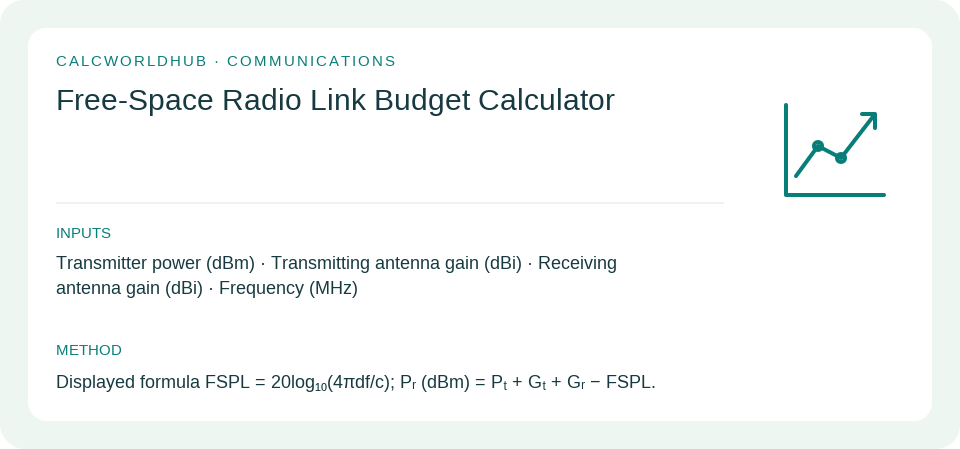
FSPL = 20log₁₀(4πdf/c); Pᵣ (dBm) = Pₜ + Gₜ + Gᵣ − FSPL.
Method
Enter transmitter power in dBm, antenna gains in dBi, frequency in MHz, and separation in kilometers. The calculator converts to SI units, estimates free-space attenuation, and adds the ideal received power in dBm.
Worked example
At 2,400 MHz over 1 km, free-space loss is about 100.05 dB. With 20 dBm transmit power and 2 dBi antennas at each end, ideal received power is about −76.05 dBm.
Assumptions and limits
This is a free-space reference estimate for an ideal unobstructed path. It excludes feeder losses, polarization mismatch, terrain, buildings, atmospheric absorption, fading, interference, receiver noise, and implementation margin; real links require a complete engineering budget.
Frequently asked questions
What does free-space path loss include?
It represents ideal geometric spreading loss for a radio wave in free space at the specified frequency and distance.
Why add antenna gains?
Directional antenna gains increase power in the link direction and are added in dB units.
Is received power a field prediction?
No. Real propagation may include obstructions, multipath, atmospheric losses, equipment losses, and interference.
How do I use the Free-Space Radio Link Budget Calculator?
Enter Transmitter power (dBm), Transmitting antenna gain (dBi), Receiving antenna gain (dBi), Frequency (MHz), then complete the remaining labeled fields. Match the units shown beside each field and review the result together with the assumptions below.
What is a worked example of Free-Space Radio Link Budget?
At 2,400 MHz over 1 km, free-space loss is about 100.05 dB. With 20 dBm transmit power and 2 dBi antennas at each end, ideal received power is about −76.05 dBm.
Reference: ITU-R P.525-5 free-space attenuation recommendation. See our calculation methodology.