How to use this calculator
Estimate a fuel higher heating value from dry-basis elemental and ash mass percentages.
- Enter Carbon C (wt%, dry basis), Hydrogen H (wt%, dry basis), Oxygen O (wt%, dry basis), Nitrogen N (wt%, dry basis), then complete the remaining labeled fields. Match the units shown beside each field and review the result together with the assumptions below.
- Read the worked example below to check the expected input format and result.
- Compare another scenario by changing one input at a time. Use Reset to return to the starting values.
How this calculation works
The Channiwala–Parikh correlation estimates higher heating value from carbon, hydrogen, sulfur, oxygen, nitrogen, and ash percentages. It is a regression correlation for fuel characterization, not a substitute for bomb calorimetry.
Inputs and units
carbon— Carbon C (wt%, dry basis)- Dry-basis carbon mass percentage.
hydrogen— Hydrogen H (wt%, dry basis)- Dry-basis hydrogen mass percentage.
oxygen— Oxygen O (wt%, dry basis)- Dry-basis oxygen mass percentage.
nitrogen— Nitrogen N (wt%, dry basis)- Dry-basis nitrogen mass percentage.
sulfur— Sulfur S (wt%, dry basis)- Dry-basis sulfur mass percentage.
ash— Ash A (wt%, dry basis)- Dry-basis ash mass percentage.
Formula
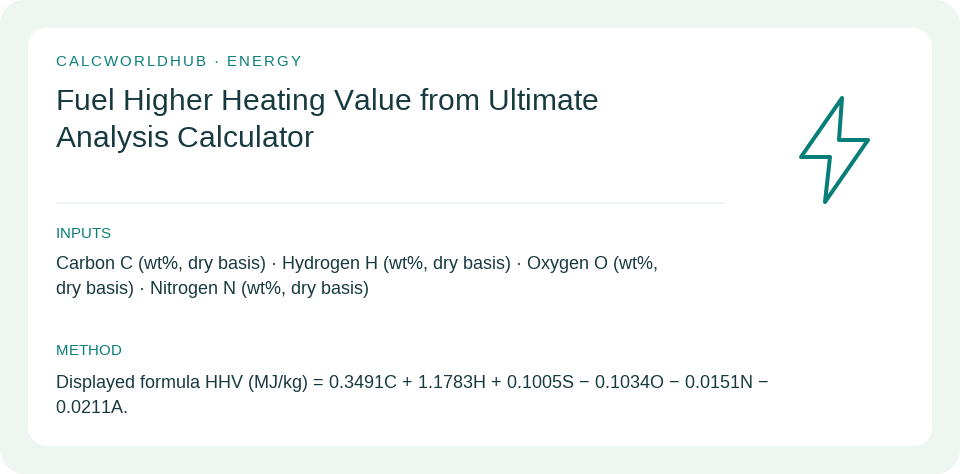
HHV (MJ/kg) = 0.3491C + 1.1783H + 0.1005S − 0.1034O − 0.0151N − 0.0211A.
Method
Apply the published coefficients to dry-basis mass percentages, then convert the estimated MJ/kg value to kJ/kg and Btu/lb.
Worked example
For dry-basis C = 50%, H = 6%, O = 42%, N = 1%, S = 0.1%, and ash = 0.9%, the estimated HHV is 20.158 MJ/kg, equivalent to 20,157.96 kJ/kg or about 8,666.4 Btu/lb.
Assumptions and limits
All entries must be dry-basis mass percentages and must not sum above 100%. This empirical equation has a stated composition domain and prediction error; it is not appropriate for every fuel or for direct process control. For critical energy balances, use measured calorimetry.
Frequently asked questions
What does higher heating value mean?
HHV includes the heat recovered when combustion water is condensed to the reference state.
Why is the result an estimate?
The equation is an empirical correlation fitted to fuels; measured calorimetry is preferable where accuracy is critical.
Can I enter as-received percentages?
No. The inputs are defined on a dry basis. Convert a wet or as-received analysis to dry-basis percentages first.
How do I use the Fuel Higher Heating Value from Ultimate Analysis Calculator?
Enter Carbon C (wt%, dry basis), Hydrogen H (wt%, dry basis), Oxygen O (wt%, dry basis), Nitrogen N (wt%, dry basis), then complete the remaining labeled fields. Match the units shown beside each field and review the result together with the assumptions below.
What is a worked example of Fuel Higher Heating Value from Ultimate Analysis?
For dry-basis C = 50%, H = 6%, O = 42%, N = 1%, S = 0.1%, and ash = 0.9%, the estimated HHV is 20.158 MJ/kg, equivalent to 20,157.96 kJ/kg or about 8,666.4 Btu/lb.
Reference: Peer-reviewed Channiwala–Parikh unified fuel HHV correlation. See our calculation methodology.