How to use this calculator
Compare the projected effect of two mutual-fund expense ratios on portfolio value and cumulative fees.
- Enter Starting investment (currency units), Contribution at each year-end (currency units), Assumed annual gross return (%), Fund A expense ratio (%), then complete the remaining labeled fields. Match the units shown beside each field and review the result together with the assumptions below.
- Read the worked example below to check the expected input format and result.
- Compare another scenario by changing one input at a time. Use Reset to return to the starting values.
How this calculation works
A fund expense ratio is an annual operating expense expressed as a percentage of fund assets. A small percentage can create a larger dollar difference over time because money spent on expenses is no longer invested. This comparison projects two fee assumptions against the same starting balance, annual contribution, gross return, and holding period.
Inputs and units
startingBalance— Starting investment (currency units)- Current value at the beginning of the first modeled year.
annualContribution— Contribution at each year-end (currency units)- Same contribution amount added after each year's modeled expense.
grossReturnPct— Assumed annual gross return (%)- A constant before-fee rate used only for this hypothetical comparison.
expenseA_pct— Fund A expense ratio (%)- Annual operating expense ratio, usually listed in the fund prospectus.
expenseB_pct— Fund B expense ratio (%)- Second annual expense ratio for comparison.
years— Holding period (years)- Whole number of annual periods, from 1 to 80.
Formula
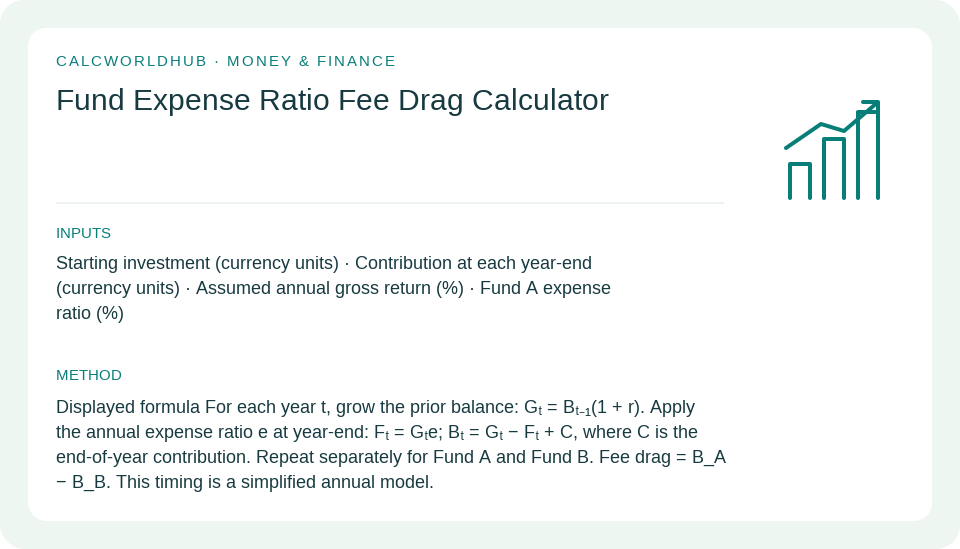
For each year t, grow the prior balance: Gₜ = Bₜ₋₁(1 + r). Apply the annual expense ratio e at year-end: Fₜ = Gₜe; Bₜ = Gₜ − Fₜ + C, where C is the end-of-year contribution. Repeat separately for Fund A and Fund B. Fee drag = B_A − B_B. This timing is a simplified annual model.
Method
The calculator applies the same assumed gross return and contribution to both scenarios once per year, deducts each expense ratio from the grown balance at year-end, and adds the contribution at year-end. It sums modeled dollar deductions and compares ending balances; intermediate values are not rounded.
Worked example
With a 10,000 starting balance, 3,000 contributed at each year-end, 7% assumed gross return, 20 years, and expense ratios of 0.04% and 0.50%, the model ends at about 160,801.67 versus 151,040.70 currency units. The ending-value difference is about 9,760.97; modeled annual deductions sum to about 558.60 and 6,706.38, respectively.
Assumptions and limits
This is an illustrative projection, not a return forecast or investment recommendation. Actual fund expenses accrue over time against average net assets, returns vary, share classes can have other fees, and taxes or transaction charges may apply. The annual year-end deduction and end-year contribution timing are simplifying assumptions for comparing two expense ratios.
Frequently asked questions
Where do I find a fund's expense ratio?
Use the fund's prospectus fee table or official shareholder materials. The ratio is an annual operating expense stated as a percentage of fund assets.
Why can a small fee difference matter over time?
Expenses reduce the assets left invested, so later returns compound on a smaller balance. The effect depends on the return path, contributions, and fee timing.
Are the ending balances guaranteed?
No. The gross return is a constant hypothetical input. Market returns vary, and the simplified annual fee timing is not a prediction of an actual fund account.
Does this include loads, taxes, or trading costs?
No. The comparison isolates two annual expense ratios. Sales loads, account fees, taxes, brokerage charges, and other fund expenses are outside the model unless they are already reflected in the entered assumptions.
How do I use the Fund Expense Ratio Fee Drag Calculator?
Enter Starting investment (currency units), Contribution at each year-end (currency units), Assumed annual gross return (%), Fund A expense ratio (%), then complete the remaining labeled fields. Match the units shown beside each field and review the result together with the assumptions below.
Reference: SEC Investor.gov expense-ratio definition and prospectus reference. See our calculation methodology.