How to use this calculator
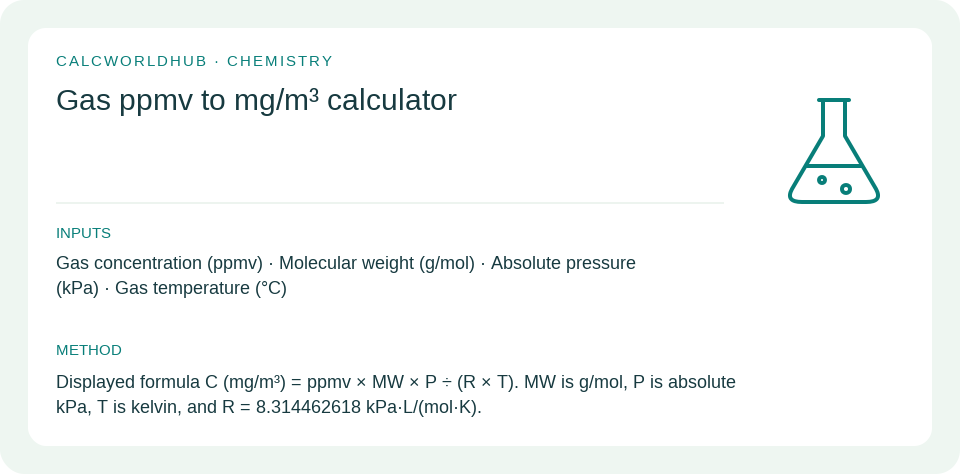
Convert a gas volume fraction in ppmv to mass concentration using molecular weight, absolute pressure, and gas temperature.
- Enter Gas concentration (ppmv), Molecular weight (g/mol), Absolute pressure (kPa), Gas temperature (°C). Match the units shown beside each field and review the result together with the assumptions below.
- Read the worked example below to check the expected input format and result.
- Compare another scenario by changing one input at a time. Use Reset to return to the starting values.
How this calculation works
A ppmv reading describes a gas by volume, while mg/m³ expresses mass in an actual air volume. The ideal-gas relationship connects them, but the conversion depends on the gas molecular weight and the temperature and absolute pressure used for the sample.
Inputs and units
ppmv— Gas concentration (ppmv)- Parts per million by volume, equivalent to micromoles of gas per mole of mixture.
molecularWeight— Molecular weight (g/mol)- Molar mass of the gas species being converted.
pressureKpa— Absolute pressure (kPa)- Use absolute barometric pressure, not gauge pressure.
temperatureC— Gas temperature (°C)- Temperature of the gas volume represented by the ppmv measurement.
Formula
C (mg/m³) = ppmv × MW × P ÷ (R × T). MW is g/mol, P is absolute kPa, T is kelvin, and R = 8.314462618 kPa·L/(mol·K).
Method
Enter the volume mixing ratio, molecular weight, absolute pressure, and temperature. Temperature is converted from °C to kelvin; the ideal-gas law then gives mass per cubic metre. Use station pressure for the physical sample condition.
Worked example
For 100 ppmv of a gas with molecular weight 28.01 g/mol at 101.325 kPa and 25 °C, T = 298.15 K and C ≈ 100 × 28.01 × 101.325 ÷ (8.314462618 × 298.15) = 114.5 mg/m³.
Assumptions and limits
This is an ideal-gas conversion, not an exposure assessment and not a substitute for a validated sampling method. It assumes the entered ppmv is a volume mixing ratio and uses the gas molecular weight as a pure component. Regulatory limits may define reference conditions and reporting rules differently; compare only on a matching basis.
Frequently asked questions
Why does temperature change the conversion?
At a fixed pressure, warmer gas has fewer moles in each cubic metre, so the same mole fraction corresponds to a different mass concentration per actual volume.
Should I enter gauge or absolute pressure?
Enter absolute pressure. Gauge pressure is measured relative to ambient pressure and must be converted before using the ideal-gas relation.
Does the result determine whether an exposure is safe?
No. It only converts units under the stated conditions. Occupational limits, averaging times, sampling methods, and reference conditions must be evaluated separately.
How do I use the Gas ppmv to mg/m³ calculator?
Enter Gas concentration (ppmv), Molecular weight (g/mol), Absolute pressure (kPa), Gas temperature (°C). Match the units shown beside each field and review the result together with the assumptions below.
What is a worked example of Gas ppmv to mg/m³?
For 100 ppmv of a gas with molecular weight 28.01 g/mol at 101.325 kPa and 25 °C, T = 298.15 K and C ≈ 100 × 28.01 × 101.325 ÷ (8.314462618 × 298.15) = 114.5 mg/m³.
Reference: OSHA Technical Manual air-contaminant conversion equations. See our calculation methodology.