Ideal gas density calculator
Find the mass per volume implied by an ideal gas at the entered pressure and temperature. Use absolute pressure and Kelvin, not gauge pressure or Celsius.
Calculator
How to use this calculator
Calculate ideal-gas density from absolute pressure, molar mass, and absolute temperature using consistent SI units.
- Enter Pressure (Pa), Molar mass (kg/mol), Temperature (K). Match the units shown beside each field and review the result together with the assumptions below.
- Read the worked example below to check the expected input format and result.
- Compare another scenario by changing one input at a time. Use Reset to return to the starting values.
Ideal gas density calculator
Find the mass per volume implied by an ideal gas at the entered pressure and temperature. Use absolute pressure and Kelvin, not gauge pressure or Celsius.
What it measures
This tool combines the ideal gas law with molar mass to estimate gas density. It is useful for a single uniform gas state when real-gas effects are small.
Inputs and units
- Pressure (Pa): Enter absolute pressure in pascals. Convert gauge pressure by adding local atmospheric pressure.
- Molar mass (kg/mol): Use the gas or mixture molar mass in kg/mol.
- Temperature (K): Enter absolute temperature in kelvin; convert °C by adding 273.15.
Formula and method
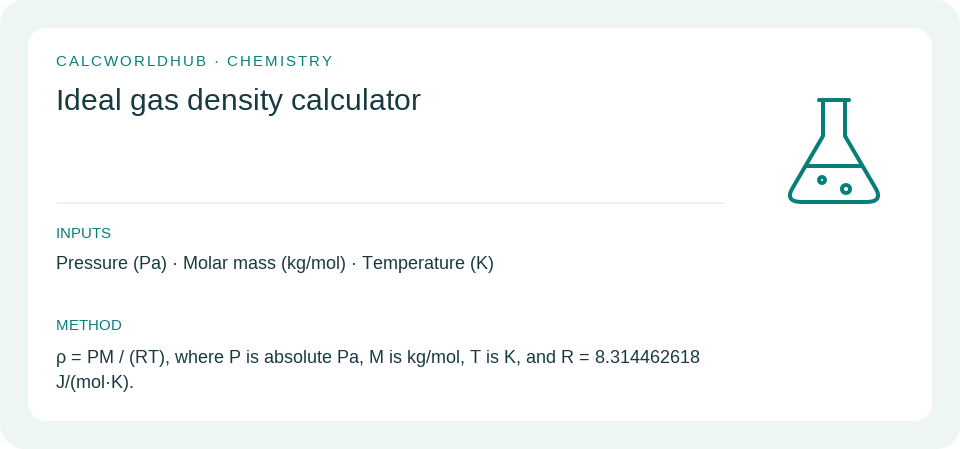
ρ = PM / (RT), where P is absolute Pa, M is kg/mol, T is K, and R = 8.314462618 J/(mol·K).
Worked example
For dry air with P = 101,325 Pa, M = 0.02897 kg/mol, and T = 298.15 K, ρ = 1.1841 kg/m³.
Interpreting the result
Higher absolute pressure raises the ideal density; higher absolute temperature lowers it for fixed molar mass. Density is reported in kg/m³.
Assumptions and limits
The formula assumes ideal behavior, one uniform temperature and pressure, and a correct mixture molar mass. At high pressure or near condensation, real-gas compressibility can matter. Zero pressure is the mathematical vacuum boundary.
Sources and method
- Provides PV=nRT; combining n/V=P/(RT) with molar mass gives ρ=PM/(RT) for an ideal gas. OpenStax College Physics 2e: The ideal gas law
Frequently asked questions
Can I enter gauge pressure?
Convert it to absolute pressure first by adding the local atmospheric pressure.
Why must temperature be in kelvin?
The ideal-gas relation uses absolute temperature, whose zero is absolute zero.
How do I use the Ideal gas density calculator?
Enter Pressure (Pa), Molar mass (kg/mol), Temperature (K). Match the units shown beside each field and review the result together with the assumptions below.
What is a worked example of Ideal gas density?
For dry air with P = 101,325 Pa, M = 0.02897 kg/mol, and T = 298.15 K, ρ = 1.1841 kg/m³.
What does the Ideal gas density calculator calculate?
Calculate ideal-gas density from absolute pressure, molar mass, and absolute temperature using consistent SI units.
See the calculation methodology.
Good calculators show their work.
CalcWorldHub is built around clear inputs and visible assumptions. Results are estimates for planning; check official sources or your provider’s terms when exact figures matter.