How to use this calculator
Calculate approximate dry-air density from measured absolute pressure and air temperature.
- Enter Absolute pressure (kPa), Air temperature (°C). Match the units shown beside each field and review the result together with the assumptions below.
- Read the worked example below to check the expected input format and result.
- Compare another scenario by changing one input at a time. Use Reset to return to the starting values.
How this calculation works
When pressure and temperature are known, the ideal-gas relation estimates dry-air density directly. This tool uses absolute pressure and temperature in kelvin, making it suitable for a measured condition; it is different from a standard-atmosphere lookup based on altitude.
Inputs and units
pressureKpa— Absolute pressure (kPa)- Use absolute atmospheric pressure, not gauge pressure.
temperatureC— Air temperature (°C)- Enter measured air temperature in degrees Celsius.
Formula
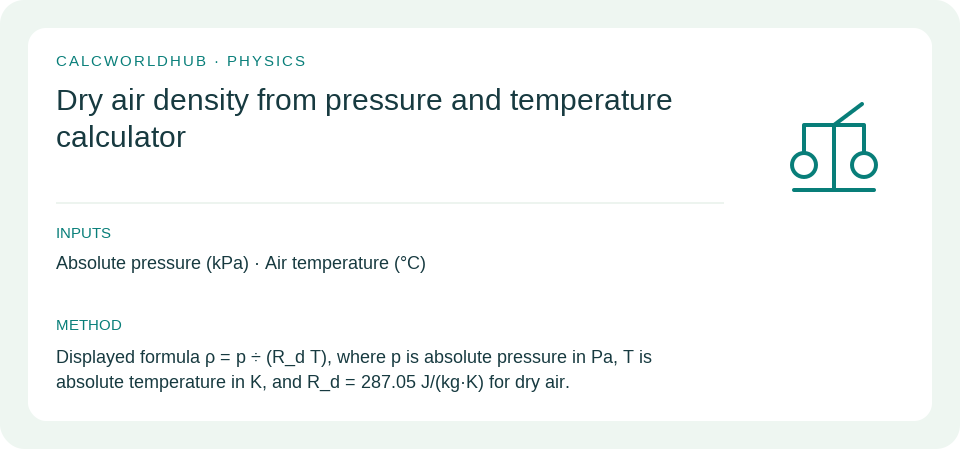
ρ = p ÷ (R_d T), where p is absolute pressure in Pa, T is absolute temperature in K, and R_d = 287.05 J/(kg·K) for dry air.
Method
Enter absolute pressure in kilopascals and temperature in degrees Celsius. The calculator converts units to pascals and kelvin, then applies the ideal-gas equation.
Worked example
At 101.325 kPa and 20°C, ρ = 101325 ÷ (287.05 × 293.15) ≈ 1.204 kg/m³ for the dry-air approximation.
Assumptions and limits
This is a dry-air ideal-gas approximation. Humidity changes air density, and non-ideal effects matter at high pressures or outside ordinary atmospheric conditions. Do not enter gauge pressure without adding ambient pressure.
Frequently asked questions
Why must I use absolute pressure?
The ideal-gas relation uses the actual thermodynamic pressure. Gauge pressure is measured above ambient and must be converted to absolute pressure first.
Does humidity matter?
Yes. Moist air has a different composition and density; this calculator deliberately assumes dry air.
How is this different from air density by altitude?
This page accepts measured pressure and temperature directly. An altitude-based standard-atmosphere model estimates reference conditions from elevation.
How do I use the Dry air density from pressure and temperature calculator?
Enter Absolute pressure (kPa), Air temperature (°C). Match the units shown beside each field and review the result together with the assumptions below.
What is a worked example of Dry air density from pressure and temperature?
At 101.325 kPa and 20°C, ρ = 101325 ÷ (287.05 × 293.15) ≈ 1.204 kg/m³ for the dry-air approximation.
Reference: NIST air-density reference. See our calculation methodology.