Ventilation air mass flow calculator
Estimate ventilation air mass flow from room volume, air changes per hour, and air density.
Calculator
How to use this calculator
Estimate ventilation air mass flow from room volume, air changes per hour, and air density.
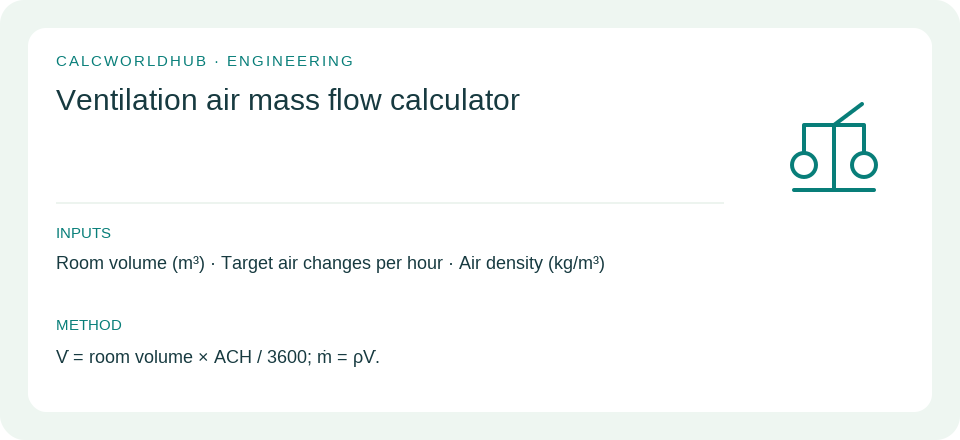
- Enter Room volume (m³), Target air changes per hour, Air density (kg/m³). Match the units shown beside each field and review the result together with the assumptions below.
- Read the worked example below to check the expected input format and result.
- Compare another scenario by changing one input at a time. Use Reset to return to the starting values.
Ventilation air mass flow calculator
Estimate ventilation air mass flow from room volume, air changes per hour, and air density.
What it measures
Air-change rate converts room volume into a volumetric flow. Multiplying by density converts that flow to mass per time.
Inputs and units
- Room volume (m³): Use the room volume in cubic metres.
- Target air changes per hour: Use the target air changes per hour for the same room and operating condition.
- Air density (kg/m³): Use air density in kg/m³ at the relevant pressure and temperature.
Formula and method
V̇ = room volume × ACH / 3600; ṁ = ρV̇.
Worked example
120 m³ × 5 h⁻¹ = 600 m³/h = 0.1667 m³/s; at 1.2 kg/m³, ṁ = 0.200 kg/s.
Interpreting the result
The result is the mass of air delivered each second at the entered density.
Assumptions and limits
This is a steady volumetric-flow estimate. It does not calculate heating load; temperature rise and specific heat are not inputs to mass flow and were removed from this page.
Sources and method
- Uses air density, specific heat, airflow, and temperature difference for ventilation heat load; this mass-flow page only uses density and volumetric flow. ASHRAE Handbook: Unit ventilators and makeup air
Frequently asked questions
Why are temperature rise and specific heat absent?
They are needed for a heat-load estimate, not for converting airflow to mass flow.
Does ACH alone determine mass flow?
No. Room volume gives volumetric flow, and air density converts it to mass flow.
How do I use the Ventilation air mass flow calculator?
Enter Room volume (m³), Target air changes per hour, Air density (kg/m³). Match the units shown beside each field and review the result together with the assumptions below.
What is a worked example of Ventilation air mass flow?
120 m³ × 5 h⁻¹ = 600 m³/h = 0.1667 m³/s; at 1.2 kg/m³, ṁ = 0.200 kg/s.
What does the Ventilation air mass flow calculator calculate?
Estimate ventilation air mass flow from room volume, air changes per hour, and air density.
See the calculation methodology.
Good calculators show their work.
CalcWorldHub is built around clear inputs and visible assumptions. Results are estimates for planning; check official sources or your provider’s terms when exact figures matter.