Ventilation sensible heat load calculator
Estimate sensible heating power for ACH ventilation from air properties and temperature rise.
Calculator
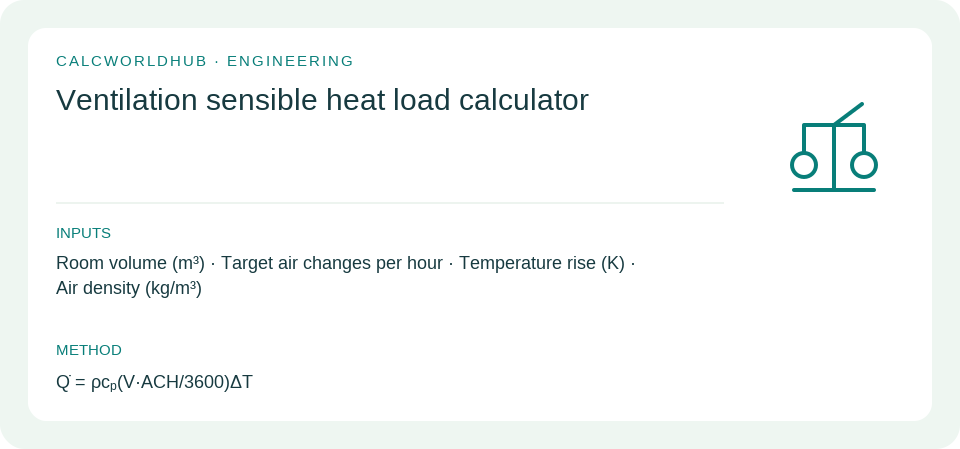
How to use this calculator
Estimate sensible heating power for ACH ventilation from air properties and temperature rise.
- Enter Room volume (m³), Target air changes per hour, Temperature rise (K), Air density (kg/m³), then complete the remaining labeled fields. Match the units shown beside each field and review the result together with the assumptions below.
- Read the worked example below to check the expected input format and result.
- Compare another scenario by changing one input at a time. Use Reset to return to the starting values.
Ventilation sensible heat load calculator
Estimate sensible heating power for ACH ventilation from air properties and temperature rise.
Inputs and units
- Room volume (m³): Enclosed room volume in m³; ACH multiplied by this volume gives m³ per hour.
- Target air changes per hour: Target replacement volume per hour as a multiple of room volume; 5 ACH means five room volumes each hour.
- Temperature rise (K): Indoor-to-supply or modeled air temperature difference in kelvins; sign follows the stated heating direction.
- Air density (kg/m³): Representative air mass density in kg/m³ at the modeled condition; real density varies with temperature, pressure, and humidity.
- Air specific heat (kJ/kg·K): Energy required per gram per kelvin for the same material; this simple product assumes it is approximately constant over the temperature interval.
Formula and method
Q̇ = ρcₚ(V·ACH/3600)ΔT
Worked example
Using ρ=1.2 kg/m³, cₚ=1.005 kJ/(kg·K), V=120 m³, ACH=5, and ΔT=12 K gives about 2.412 kW.
Interpreting the result
Positive temperature rise gives heating load in this convention; reversing the indoor-outdoor difference changes the sign.
Assumptions and limits
Airflow and air properties must be nonnegative, room volume positive. Assumes steady sensible-only load and representative density/specific heat; latent load, recovery, leakage, and fan heat are omitted.
Sources and method
- Relates airflow heat removal to air density, specific heat, airflow, and temperature difference; ACH conversion is volume balance per hour. U.S. Department of Energy handbook: ventilation airflow and heat load
Frequently asked questions
Which inputs determine this result?
The visible inputs are Room volume (m³), Target air changes per hour, Temperature rise (K), Air density (kg/m³), Air specific heat (kJ/kg·K). Each is used by the displayed formula; the calculator does not use any other hidden measurement.
When does this method apply?
Airflow and air properties must be nonnegative, room volume positive. Assumes steady sensible-only load and representative density/specific heat; latent load, recovery, leakage, and fan heat are omitted.
How do I use the Ventilation sensible heat load calculator?
Enter Room volume (m³), Target air changes per hour, Temperature rise (K), Air density (kg/m³), then complete the remaining labeled fields. Match the units shown beside each field and review the result together with the assumptions below.
What is a worked example of Ventilation sensible heat load?
Using ρ=1.2 kg/m³, cₚ=1.005 kJ/(kg·K), V=120 m³, ACH=5, and ΔT=12 K gives about 2.412 kW.
What does the Ventilation sensible heat load calculator calculate?
Estimate sensible heating power for ACH ventilation from air properties and temperature rise.
See the calculation methodology.
Good calculators show their work.
CalcWorldHub is built around clear inputs and visible assumptions. Results are estimates for planning; check official sources or your provider’s terms when exact figures matter.