How to use this calculator
Estimate standard-atmosphere pressure, temperature, and air density from altitude in the troposphere.
- Enter Geopotential altitude (m). Match the units shown beside each field and review the result together with the assumptions below.
- Read the worked example below to check the expected input format and result.
- Compare another scenario by changing one input at a time. Use Reset to return to the starting values.
How this calculation works
A standard atmosphere is a reference model for how pressure, temperature, and density vary with altitude. This calculator applies the constant-lapse-rate troposphere equations, so its output is a reference condition rather than current weather at a location.
Inputs and units
altitude— Geopotential altitude (m)- Enter height above mean sea level for the troposphere model, from −500 to 11,000 m.
Formula
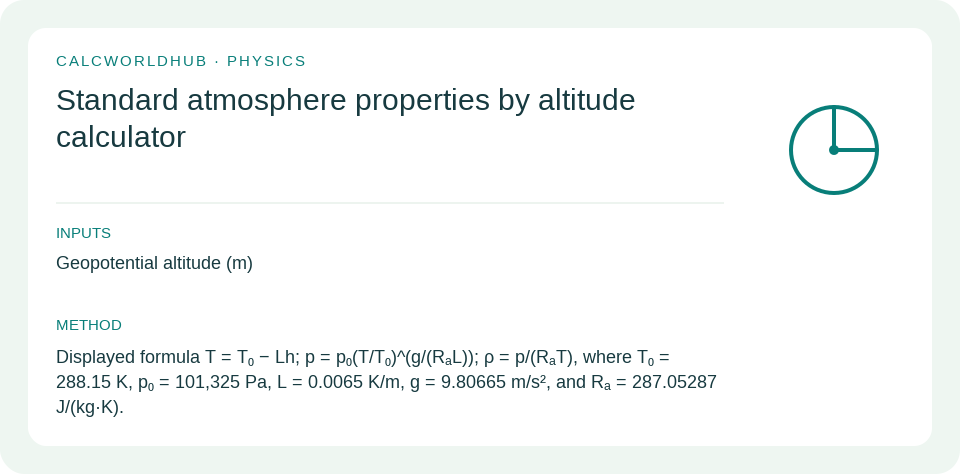
T = T₀ − Lh; p = p₀(T/T₀)^(g/(RₐL)); ρ = p/(RₐT), where T₀ = 288.15 K, p₀ = 101,325 Pa, L = 0.0065 K/m, g = 9.80665 m/s², and Rₐ = 287.05287 J/(kg·K).
Method
Enter geopotential altitude in metres. The model calculates standard temperature first, then pressure from the troposphere power law and density from the dry-air equation of state.
Worked example
At 1,500 m, the model gives a standard temperature of 5.25°C, pressure of about 84.556 kPa, and dry-air density of about 1.0581 kg/m³.
Assumptions and limits
This simplified single-layer model is limited to altitudes from −500 m through 11,000 m. Actual pressure and temperature vary with weather, latitude, and local conditions; this is not an altimeter calibration or flight-performance determination.
Frequently asked questions
Is this the measured pressure at my location?
No. It is a standard-atmosphere reference; weather and location can make actual pressure different.
Why is the altitude range limited?
This equation assumes a fixed temperature lapse rate in the troposphere and is not used here above its 11 km layer boundary.
Can this estimate air density for a real engine test?
Only as a reference estimate. Use measured local pressure, temperature, and humidity when test accuracy matters.
How do I use the Standard atmosphere properties by altitude calculator?
Enter Geopotential altitude (m). Match the units shown beside each field and review the result together with the assumptions below.
What is a worked example of Standard atmosphere properties by altitude?
At 1,500 m, the model gives a standard temperature of 5.25°C, pressure of about 84.556 kPa, and dry-air density of about 1.0581 kg/m³.
Reference: NASA Glenn standard atmosphere model. See our calculation methodology.