How to use this calculator
Estimate dilute-air dynamic viscosity across temperature with Sutherland's law.
- Enter Gas temperature, T (K), Reference dynamic viscosity, μ₀ (Pa·s), Reference temperature, T₀ (K), Sutherland temperature, S (K). Match the units shown beside each field and review the result together with the assumptions below.
- Read the worked example below to check the expected input format and result.
- Compare another scenario by changing one input at a time. Use Reset to return to the starting values.
How this calculation works
Sutherland's law approximates how a dilute gas's dynamic viscosity changes with absolute temperature. The reference viscosity, reference temperature, and Sutherland temperature identify the gas model; the default constants are a common air approximation.
Inputs and units
temperatureK— Gas temperature, T (K)- Absolute gas temperature at which viscosity is estimated.
referenceViscosity— Reference dynamic viscosity, μ₀ (Pa·s)- Viscosity used with the reference and Sutherland temperatures.
referenceTemperatureK— Reference temperature, T₀ (K)- Absolute reference temperature for μ₀.
sutherlandTemperatureK— Sutherland temperature, S (K)- Gas-specific Sutherland temperature constant.
Formula
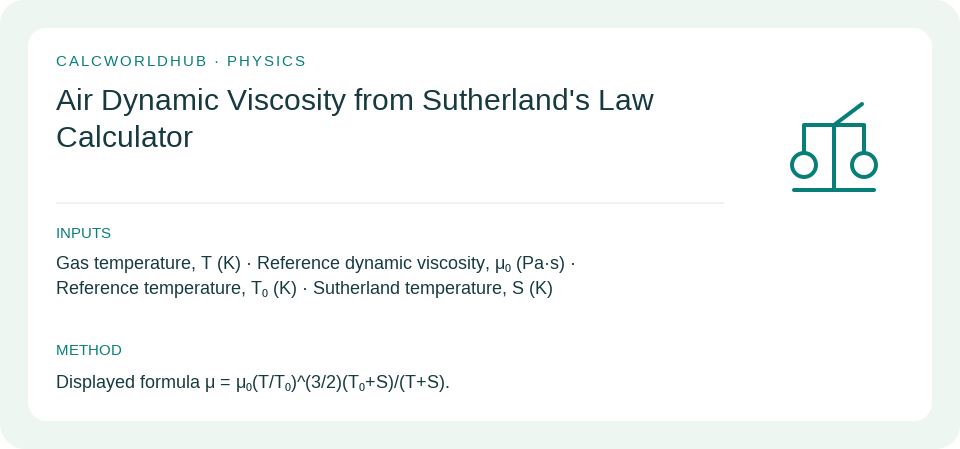
μ = μ₀(T/T₀)^(3/2)(T₀+S)/(T+S).
Method
Convert no units internally because all temperature inputs use kelvin. Apply the temperature ratio and Sutherland correction to the stated reference viscosity. The resulting dynamic viscosity is returned in pascal-seconds.
Worked example
For air with μ₀ = 1.716×10⁻⁵ Pa·s at T₀ = 273.15 K and S = 110.4 K, the estimate at 300 K is 18.459 µPa·s.
Assumptions and limits
This is a dilute single-gas approximation and does not model pressure dependence, real-gas effects, or mixture viscosity rules. Use reference constants appropriate for the gas and temperature range.
Frequently asked questions
Why use a reference viscosity?
Sutherland's relation scales a known viscosity at a reference temperature to another temperature.
Does pressure affect this result?
Pressure is not an input in this dilute-gas approximation.
Can these constants be used for another gas?
Only if the selected reference viscosity, reference temperature, and Sutherland constant are appropriate for that gas.
How do I use the Air Dynamic Viscosity from Sutherland's Law Calculator?
Enter Gas temperature, T (K), Reference dynamic viscosity, μ₀ (Pa·s), Reference temperature, T₀ (K), Sutherland temperature, S (K). Match the units shown beside each field and review the result together with the assumptions below.
What is a worked example of Air Dynamic Viscosity from Sutherland's Law?
For air with μ₀ = 1.716×10⁻⁵ Pa·s at T₀ = 273.15 K and S = 110.4 K, the estimate at 300 K is 18.459 µPa·s.
Reference: NASA Wind-US guide to Sutherland viscosity and species reference constants. See our calculation methodology.