How to use this calculator
Propagate an ideal Gaussian waist to obtain beam radius, Rayleigh range, wavefront curvature, and far-field divergence.
- Enter Waist 1/e² intensity radius (mm), Vacuum wavelength (nm), Medium refractive index, Signed distance from waist (m). Match the units shown beside each field and review the result together with the assumptions below.
- Read the worked example below to check the expected input format and result.
- Compare another scenario by changing one input at a time. Use Reset to return to the starting values.
Gaussian beam free space propagation explained
Use Waist 1/e² intensity radius (mm) with Vacuum wavelength (nm) to reproduce the sample calculation, then review the stated limits before carrying the result into another scenario.
A numerical walkthrough
Waist 1/e² intensity radius (mm) = 0.5; Vacuum wavelength (nm) = 1064; Medium refractive index = 1; Signed distance from waist (m) = 1.
- Beam radius at selected distance: 0.84191521 mm
- Rayleigh range: 0.73815617 m
- Wavefront radius of curvature: 1.54487453 m
- Far-field half-angle divergence: 0.0006773634 rad
At 1 m, the beam radius is about 0.842 mm, larger than the 0.5 mm waist because the propagation distance exceeds the 0.738 m Rayleigh range. This ideal Gaussian estimate does not account for clipping or aberrations.
The model behind the numbers
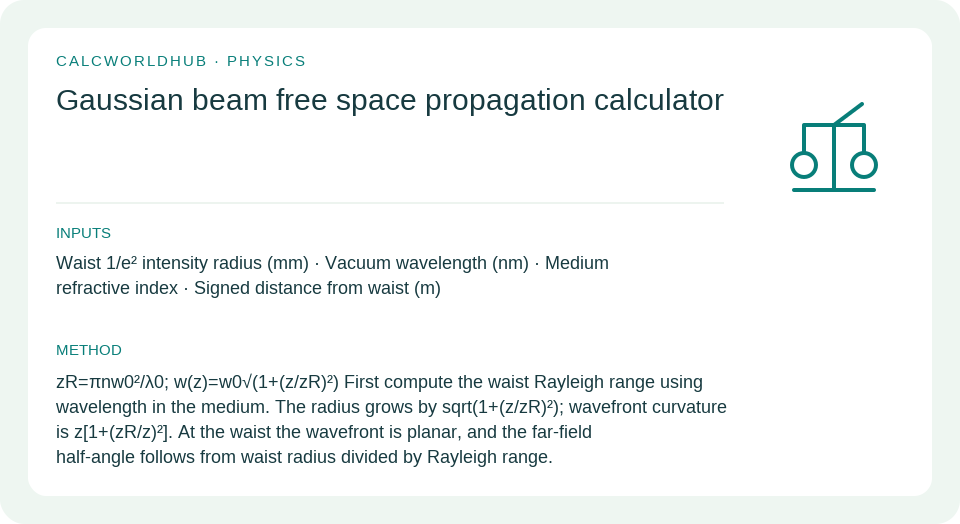
zR=πnw0²/λ0; w(z)=w0√(1+(z/zR)²)
First compute the waist Rayleigh range using wavelength in the medium. The radius grows by sqrt(1+(z/zR)²); wavefront curvature is z[1+(zR/z)²]. At the waist the wavefront is planar, and the far-field half-angle follows from waist radius divided by Rayleigh range.
What to enter
w— Waist 1/e² intensity radius (mm)- Waist 1/e² intensity radius (mm).
l— Vacuum wavelength (nm)- Vacuum wavelength (nm).
n— Medium refractive index- Medium refractive index.
z— Signed distance from waist (m)- Signed distance from waist (m).
Interpreting the result
Paraxial fundamental Gaussian mode with M²=1 and a homogeneous nonabsorbing medium. Radius is not beam diameter.
Frequently asked questions
Which beam radius convention is used?
The intensity falls to 1/e² of its axis value at w.
What happens at the waist?
Wavefront curvature is infinite and radius equals w0.
Does it include a real beam quality factor?
No, this version assumes M²=1.
How do I use the Gaussian beam free space propagation calculator?
Enter Waist 1/e² intensity radius (mm), Vacuum wavelength (nm), Medium refractive index, Signed distance from waist (m). Match the units shown beside each field and review the result together with the assumptions below.
What is a worked example of Gaussian beam free space propagation?
Waist 1/e² intensity radius (mm) = 0.5; Vacuum wavelength (nm) = 1064; Medium refractive index = 1; Signed distance from waist (m) = 1. Beam radius at selected distance: 0.84191521 mm Rayleigh range: 0.73815617 m Wavefront radius of curvature: 1.54487453 m Far-field half-angle divergence: 0.0006773634 rad At 1 m, the beam radius is about 0.842 mm, larger than the 0.5 mm waist because the propagation distance exceeds the 0.738 m Rayleigh range. This ideal Gaussian estimate does not account for clipping or aberrations.
Method reference: Edmund Optics Gaussian beam propagation.
Read our calculation methodology.