How to use this calculator
Use the complex Gaussian beam parameter to find the new waist location and size after one ideal thin lens in air.
- Enter Input waist radius (mm), Vacuum wavelength (nm), Lens location after input waist (m), Lens focal length (m). Match the units shown beside each field and review the result together with the assumptions below.
- Read the worked example below to check the expected input format and result.
- Compare another scenario by changing one input at a time. Use Reset to return to the starting values.
Gaussian beam through a thin lens explained
The thin lens transforms the beam’s complex q parameter; the real component locates the new waist and its imaginary component determines the new Rayleigh range.
Inputs, symbols, and units
w— Input waist radius (mm)- Input waist radius (mm).
l— Vacuum wavelength (nm)- Vacuum wavelength (nm).
z— Lens location after input waist (m)- Lens location after input waist (m).
f— Lens focal length (m)- Lens focal length (m).
Formula and method
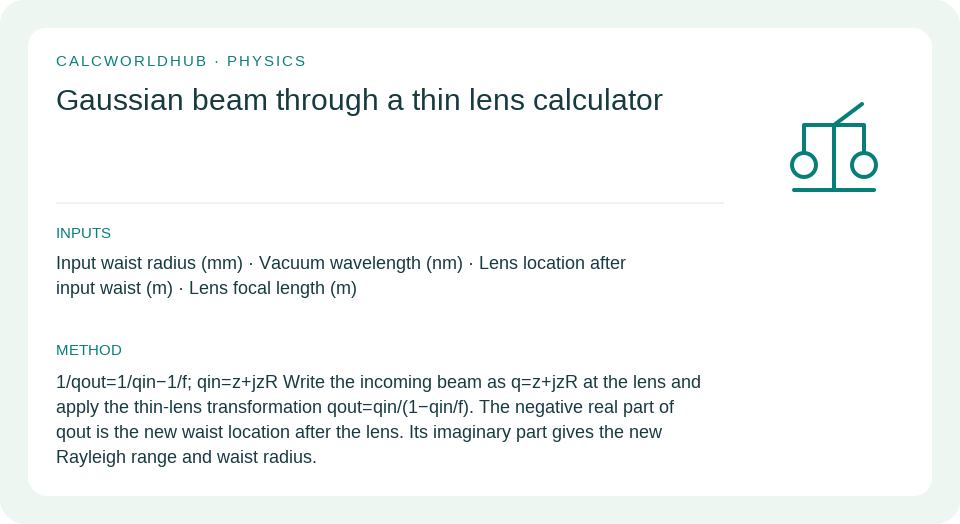
1/qout=1/qin−1/f; qin=z+jzR
Write the incoming beam as q=z+jzR at the lens and apply the thin-lens transformation qout=qin/(1−qin/f). The negative real part of qout is the new waist location after the lens. Its imaginary part gives the new Rayleigh range and waist radius.
A worked scenario
Input waist radius (mm) = 0.5; Vacuum wavelength (nm) = 1064; Lens location after input waist (m) = 1; Lens focal length (m) = 0.2.
- New waist distance after lens: 0.22700708 m
- New waist radius: 0.09186791 mm
- New Rayleigh range: 0.0249193 m
For the entered 0.5 mm waist, 1064 nm wavelength, 1 m lens position, and 0.2 m focal length, the new waist lies about 0.227 m downstream.
Assumptions and edge cases
Paraxial M²=1 beam, air on both sides, and a zero-thickness lens; negative focal lengths are allowed but zero is not.
Frequently asked questions
What does positive waist distance mean?
The new waist lies downstream of the lens.
Is a virtual upstream waist possible?
Yes, a negative distance indicates an upstream waist location.
Does this use geometric image distance alone?
No, finite Rayleigh range is included through q.
How do I use the Gaussian beam through a thin lens calculator?
Enter Input waist radius (mm), Vacuum wavelength (nm), Lens location after input waist (m), Lens focal length (m). Match the units shown beside each field and review the result together with the assumptions below.
What is a worked example of Gaussian beam through a thin lens?
Input waist radius (mm) = 0.5; Vacuum wavelength (nm) = 1064; Lens location after input waist (m) = 1; Lens focal length (m) = 0.2. New waist distance after lens: 0.22700708 m New waist radius: 0.09186791 mm New Rayleigh range: 0.0249193 m For the entered 0.5 mm waist, 1064 nm wavelength, 1 m lens position, and 0.2 m focal length, the new waist lies about 0.227 m downstream.
Read our calculation methodology.