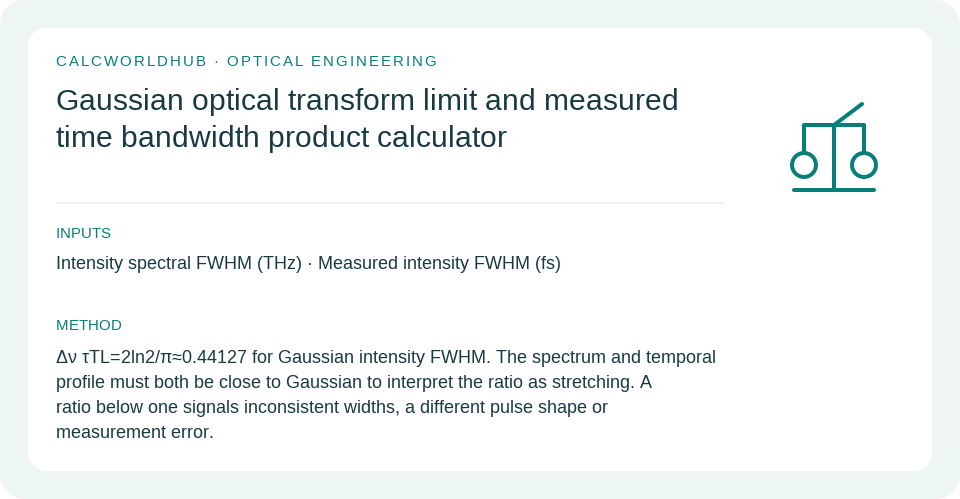
How to use this calculator
Compare a measured Gaussian optical pulse duration with the shortest Gaussian duration allowed by its frequency bandwidth.
- Enter Intensity spectral FWHM (THz), Measured intensity FWHM (fs). Match the units shown beside each field and review the result together with the assumptions below.
- Read the worked example below to check the expected input format and result.
- Compare another scenario by changing one input at a time. Use Reset to return to the starting values.
Gaussian optical transform limit and measured time bandwidth product explained
For a Gaussian pulse, the intensity-FWHM time-bandwidth product at the transform limit is about 0.441. Comparing measured duration and spectral width can show temporal broadening when both widths describe the same pulse and are measured consistently.
Inputs, symbols, and units
frequencyWidth— Intensity spectral FWHM (THz)- Measured optical bandwidth in ordinary frequency, not angular frequency.
duration— Measured intensity FWHM (fs)- Measured temporal pulse width.
Formula and method
Δν τTL=2ln2/π≈0.44127 for Gaussian intensity FWHM.
The spectrum and temporal profile must both be close to Gaussian to interpret the ratio as stretching. A ratio below one signals inconsistent widths, a different pulse shape or measurement error.
A worked scenario
Intensity spectral FWHM (THz) = 5; Measured intensity FWHM (fs) = 120.
- Gaussian transform limited FWHM: 88.25424 fs
- Measured time bandwidth product: 0.6
- Measured to transform limit ratio: 1.359708
A 5 THz Gaussian intensity bandwidth permits approximately 88.25 fs; a measured 120 fs pulse is about 1.36 times that limit.
Assumptions and edge cases
No phase retrieval and no general bound for arbitrary shapes. Sech-squared pulses have a different FWHM product; wavelength bandwidth needs careful conversion.
Reading the outputs
Transform-limited duration is fs; product and duration ratio are dimensionless.
Frequently asked questions
Can a result below one be accepted numerically?
Yes, but it is inconsistent with the assumed Gaussian model; it is a diagnostic rather than a forced correction.
Is bandwidth entered in radians per second?
No. Enter ordinary frequency FWHM in THz.
Does the ratio reveal the chirp sign?
No. Widths alone do not determine spectral phase sign.
How do I use the Gaussian optical transform limit and measured time bandwidth product calculator?
Enter Intensity spectral FWHM (THz), Measured intensity FWHM (fs). Match the units shown beside each field and review the result together with the assumptions below.
What is a worked example of Gaussian optical transform limit and measured time bandwidth product?
Intensity spectral FWHM (THz) = 5; Measured intensity FWHM (fs) = 120. Gaussian transform limited FWHM: 88.25424 fs Measured time bandwidth product: 0.6 Measured to transform limit ratio: 1.359708 A 5 THz Gaussian intensity bandwidth permits approximately 88.25 fs; a measured 120 fs pulse is about 1.36 times that limit.
Background or definition reference: MIT Ultrafast Optics, pulse propagation and characterization.
Read our calculation methodology.