How to use this calculator
Predict how a quadratic optical spectral phase stretches an initially transform-limited Gaussian pulse.
- Enter Input intensity FWHM (fs), Applied group delay dispersion (fs²). Match the units shown beside each field and review the result together with the assumptions below.
- Read the worked example below to check the expected input format and result.
- Compare another scenario by changing one input at a time. Use Reset to return to the starting values.
Gaussian optical pulse broadening by GDD explained
Estimate broadening of a transform-limited Gaussian pulse under a specified quadratic spectral phase.
How the calculation works
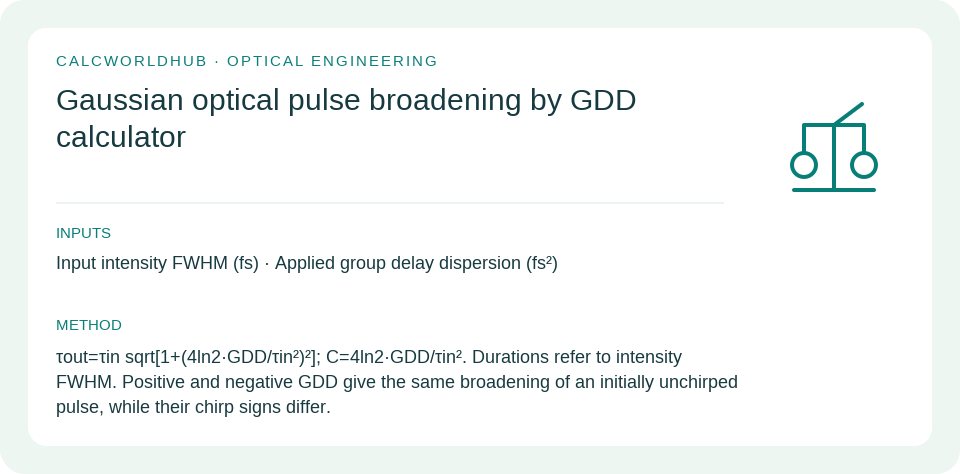
τout=τin sqrt[1+(4ln2·GDD/τin²)²]; C=4ln2·GDD/τin².
Durations refer to intensity FWHM. Positive and negative GDD give the same broadening of an initially unchirped pulse, while their chirp signs differ.
Set up the calculation
duration— Input intensity FWHM (fs)- Transform-limited Gaussian pulse duration.
gdd— Applied group delay dispersion (fs²)- Signed second derivative of spectral phase with respect to angular frequency.
Limits of this model
Gaussian transform-limited input and only quadratic spectral phase. An already chirped pulse, third-order dispersion or nonlinear propagation needs a fuller model.
Check this example
Input intensity FWHM (fs) = 100; Applied group delay dispersion (fs²) = 3000.
- Output intensity FWHM: 130.071224 fs
- Temporal broadening factor: 1.300712
- Dimensionless chirp parameter: 0.831777
A 100 fs input through 3000 fs² of GDD emerges at approximately 130.1 fs.
Reading the outputs
The output duration is fs, broadening factor is dimensionless and chirp parameter carries the signed phase convention.
Frequently asked questions
Can negative GDD compress this input?
An initially transform-limited pulse cannot be shortened by quadratic phase; a previously chirped pulse can.
Is FWHM an electric-field width?
No. This page uses the intensity width.
Does pulse energy decrease during stretching?
Pure phase dispersion preserves energy in this model.
How do I use the Gaussian optical pulse broadening by GDD calculator?
Enter Input intensity FWHM (fs), Applied group delay dispersion (fs²). Match the units shown beside each field and review the result together with the assumptions below.
What is a worked example of Gaussian optical pulse broadening by GDD?
Input intensity FWHM (fs) = 100; Applied group delay dispersion (fs²) = 3000. Output intensity FWHM: 130.071224 fs Temporal broadening factor: 1.300712 Dimensionless chirp parameter: 0.831777 A 100 fs input through 3000 fs² of GDD emerges at approximately 130.1 fs.
Background or definition reference: MIT Ultrafast Optics, pulse propagation and characterization.
Read our calculation methodology.