How to use this calculator
Convert a fiber datasheet dispersion slope into differential optical delay and the equivalent second-order spectral-phase coefficient.
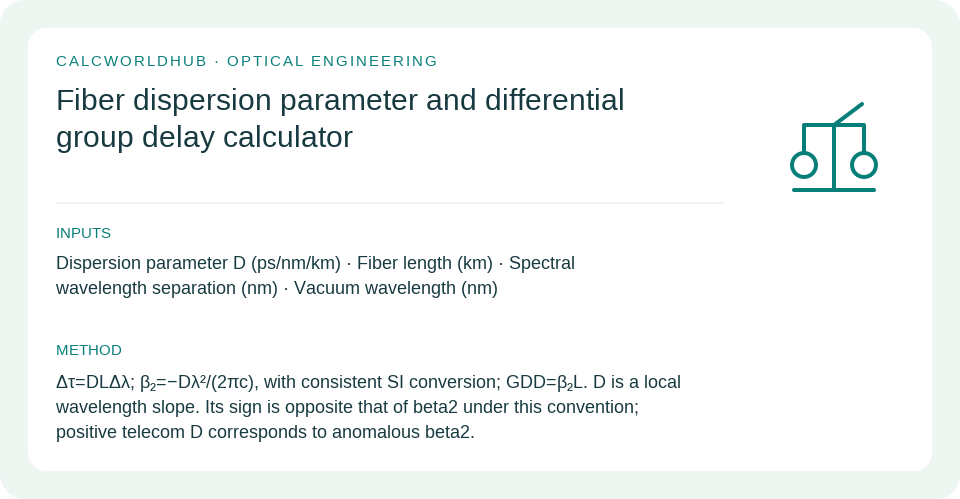
- Enter Dispersion parameter D (ps/nm/km), Fiber length (km), Spectral wavelength separation (nm), Vacuum wavelength (nm). Match the units shown beside each field and review the result together with the assumptions below.
- Read the worked example below to check the expected input format and result.
- Compare another scenario by changing one input at a time. Use Reset to return to the starting values.
Fiber dispersion parameter and differential group delay explained
For a narrow spectral separation, differential group delay is the local dispersion slope multiplied by fiber length and wavelength separation. The beta₂ conversion uses the entered vacuum wavelength and the stated sign convention; it does not model attenuation or higher-order dispersion.
Inputs, symbols, and units
D— Dispersion parameter D (ps/nm/km)- Signed wavelength derivative of group delay per fiber length.
length— Fiber length (km)- Propagation length.
delta— Spectral wavelength separation (nm)- Signed separation between two narrow spectral components.
wavelength— Vacuum wavelength (nm)- Monochromatic vacuum wavelength in nanometres.
Formula and method
Δτ=DLΔλ; β₂=−Dλ²/(2πc), with consistent SI conversion; GDD=β₂L.
D is a local wavelength slope. Its sign is opposite that of beta2 under this convention; positive telecom D corresponds to anomalous beta2.
A worked scenario
Dispersion parameter D (ps/nm/km) = 17; Fiber length (km) = 2; Spectral wavelength separation (nm) = 0.4; Vacuum wavelength (nm) = 1550.
- Differential group delay: 13.6 ps
- Group velocity dispersion beta2: -21.682619 ps²/km
- Accumulated group delay dispersion: -43.365239 ps²
D=17 ps/nm/km over 2 km separates components 0.4 nm apart by 13.6 ps.
Assumptions and edge cases
A narrow band with locally constant D; this is group-delay dispersion, not attenuation or a data-rate guarantee. Higher-order dispersion is absent.
Reading the outputs
Differential delay is signed ps, beta2 is ps²/km and accumulated GDD is ps².
Frequently asked questions
Why are D and beta2 signs opposite?
Wavelength decreases when angular frequency increases, producing the minus sign in the derivative conversion.
Is differential delay the total transit time?
No. It is the difference between two nearby spectral components.
Can I infer a pulse width from this alone?
Only with an input spectrum and pulse model; the Gaussian GDD page supplies one such model.
How do I use the Fiber dispersion parameter and differential group delay calculator?
Enter Dispersion parameter D (ps/nm/km), Fiber length (km), Spectral wavelength separation (nm), Vacuum wavelength (nm). Match the units shown beside each field and review the result together with the assumptions below.
What is a worked example of Fiber dispersion parameter and differential group delay?
Dispersion parameter D (ps/nm/km) = 17; Fiber length (km) = 2; Spectral wavelength separation (nm) = 0.4; Vacuum wavelength (nm) = 1550. Differential group delay: 13.6 ps Group velocity dispersion beta2: -21.682619 ps²/km Accumulated group delay dispersion: -43.365239 ps² D=17 ps/nm/km over 2 km separates components 0.4 nm apart by 13.6 ps.
Background or definition reference: MIT Ultrafast Optics, pulse propagation and characterization.
Read our calculation methodology.