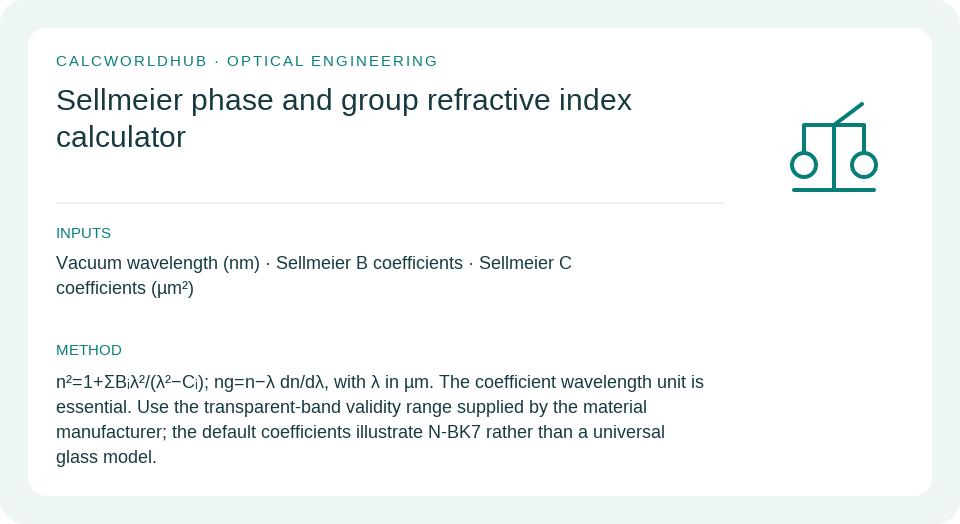
How to use this calculator
Evaluate material phase index and group index from user-supplied Sellmeier coefficients for pulse and ray calculations.
- Enter Vacuum wavelength (nm), Sellmeier B coefficients, Sellmeier C coefficients (µm²). Match the units shown beside each field and review the result together with the assumptions below.
- Read the worked example below to check the expected input format and result.
- Compare another scenario by changing one input at a time. Use Reset to return to the starting values.
Sellmeier phase and group refractive index explained
How the calculation works
n²=1+ΣBᵢλ²/(λ²−Cᵢ); ng=n−λ dn/dλ, with λ in µm.
The coefficient wavelength unit is essential. Use the transparent-band validity range supplied by the material manufacturer; the default coefficients illustrate N-BK7 rather than a universal glass model.
Set up the calculation
wavelength— Vacuum wavelength (nm)- Monochromatic vacuum wavelength in nanometres.
B— Sellmeier B coefficients- Three dimensionless strengths from a material datasheet. Use comma-separated values in the stated order.
C— Sellmeier C coefficients (µm²)- Three squared-resonance-wavelength coefficients using micrometres. Use comma-separated values in the stated order.
Limits of this model
Three-term transparent-medium model only. Poles, absorption bands, temperature and stress effects are not modeled; do not extrapolate beyond the supplied datasheet range.
Check this example
Vacuum wavelength (nm) = 587.6; Sellmeier B coefficients = [1.03961212, 0.231792344, 1.01046945]; Sellmeier C coefficients (µm²) = [0.00600069867, 0.0200179144, 103.560653].
- Phase refractive index: 1.516798
- Group refractive index: 1.541355
- Index wavelength derivative: -0.041792 per micrometre
At 587.6 nm the displayed N-BK7 coefficients give phase index approximately 1.5168; group index is higher because the glass is dispersive.
Reading the outputs
Phase and group indices are dimensionless; derivative is index change per micrometre.
Frequently asked questions
Can I paste coefficients expressed in nanometres?
Only after converting their C coefficients to squared micrometres.
Why are phase and group index different?
The derivative of index changes the envelope propagation speed.
Are these coefficients valid for every glass?
No. Replace all six coefficients with those of the actual material.
How do I use the Sellmeier phase and group refractive index calculator?
Enter Vacuum wavelength (nm), Sellmeier B coefficients, Sellmeier C coefficients (µm²). Match the units shown beside each field and review the result together with the assumptions below.
What is a worked example of Sellmeier phase and group refractive index?
Vacuum wavelength (nm) = 587.6; Sellmeier B coefficients = [1.03961212, 0.231792344, 1.01046945]; Sellmeier C coefficients (µm²) = [0.00600069867, 0.0200179144, 103.560653]. Phase refractive index: 1.516798 Group refractive index: 1.541355 Index wavelength derivative: -0.041792 per micrometre At 587.6 nm the displayed N-BK7 coefficients give phase index approximately 1.5168; group index is higher because the glass is dispersive.
Background or definition reference: SCHOTT optical glass technical information.
Read our calculation methodology.