How to use this calculator
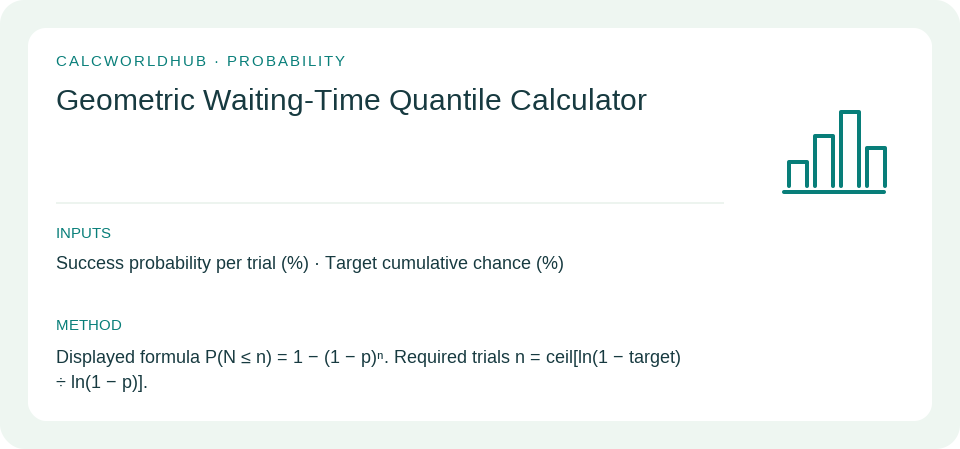
Find the minimum independent trial count needed to reach a target chance of at least one success.
- Enter Success probability per trial (%), Target cumulative chance (%). Match the units shown beside each field and review the result together with the assumptions below.
- Read the worked example below to check the expected input format and result.
- Compare another scenario by changing one input at a time. Use Reset to return to the starting values.
How this calculation works
The geometric waiting-time distribution describes the number of independent trials up to and including the first success. Enter the same success probability for every trial and a cumulative probability target; the result is the smallest whole number of attempts that reaches that target.
Inputs and units
successProbabilityPct— Success probability per trial (%)- Use the probability of success on one independent trial.
targetChancePct— Target cumulative chance (%)- Choose a cumulative probability strictly above 0% and below 100%.
Formula
P(N ≤ n) = 1 − (1 − p)ⁿ. Required trials n = ceil[ln(1 − target) ÷ ln(1 − p)].
Method
The calculator solves the geometric cumulative distribution for n and rounds up to the next whole trial. It then recomputes the achieved cumulative probability at that integer count.
Worked example
With a 20% success chance per independent trial and a 90% target, n = ceil[ln(0.10) ÷ ln(0.80)] = 11 trials. The achieved chance is 1 − 0.8¹¹ ≈ 91.41%.
Assumptions and limits
Trials must be independent and have a constant success probability. Real processes may have changing odds, dependence, stopping rules, or unmodeled costs; the result is a probability model, not a guarantee.
Frequently asked questions
Does the result guarantee a success by that count?
No. It is the count at which the model’s cumulative chance reaches the target; an outcome can still fail.
Why does the formula use the chance of no success?
The chance of zero successes in n independent trials is (1 − p)ⁿ, so the chance of at least one is one minus that value.
Can I use this for trials with different probabilities?
No. This geometric model assumes the same independent probability on every trial. Use an unequal-probability model for changing odds.
Why is a 100% cumulative target excluded?
If per-trial success is below 100%, no finite trial count reaches exactly 100% probability.
How do I use the Geometric Waiting-Time Quantile Calculator?
Enter Success probability per trial (%), Target cumulative chance (%). Match the units shown beside each field and review the result together with the assumptions below.
Read our calculation methodology.