How to use this calculator
Estimate a serving's glycemic load from its glycemic index and available carbohydrate grams.
- Enter Glycemic index (GI, glucose = 100), Available carbohydrate per serving (g). Match the units shown beside each field and review the result together with the assumptions below.
- Read the worked example below to check the expected input format and result.
- Compare another scenario by changing one input at a time. Use Reset to return to the starting values.
How this calculation works
Glycemic load combines a food's glycemic-index value with the amount of digestible carbohydrate in the portion. This calculator estimates the standard serving-level arithmetic when a GI and available-carbohydrate value are already known; it does not predict an individual's blood-glucose response.
Inputs and units
glycemicIndex— Glycemic index (GI, glucose = 100)- Enter a published or otherwise selected GI value from 0 to 100.
availableCarbsG— Available carbohydrate per serving (g)- Enter digestible carbohydrate in the portion; do not enter a per-100-g value unless that is the serving.
Formula
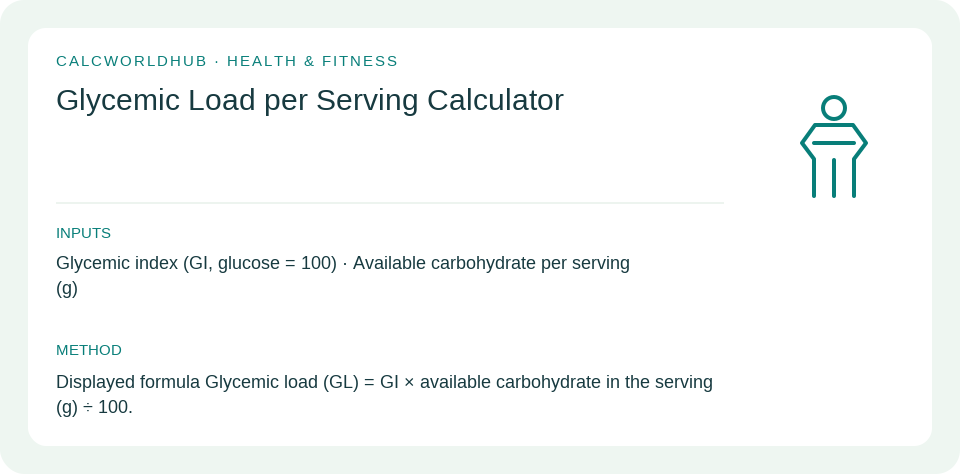
Glycemic load (GL) = GI × available carbohydrate in the serving (g) ÷ 100.
Method
Enter a glycemic-index value on the 0–100 scale and grams of available carbohydrate in the actual serving. The result scales the index by portion carbohydrate rather than treating GI alone as a serving-size measure.
Worked example
A serving with GI 55 and 30 g of available carbohydrate has GL = 55 × 30 ÷ 100 = 16.5.
Assumptions and limits
This is a food-composition estimate, not a medical assessment or a prediction of an individual's glucose response. GI values vary with food variety, preparation, processing, and test method; use available carbohydrate rather than blindly substituting total carbohydrate when fiber is included. Consult a qualified clinician for personal diabetes or dietary decisions.
Frequently asked questions
Does a GI score describe one serving size?
GI is measured from a standardized carbohydrate portion; glycemic load adds the amount of carbohydrate in the serving you actually enter.
Should I enter total or available carbohydrate?
Use available, digestible carbohydrate. If a nutrition label reports total carbohydrate including fiber, account for fiber using the method applicable to that label and jurisdiction.
Does the number predict my blood-glucose reading?
No. It is a food-level estimate and does not include individual physiology, mixed-meal effects, medication, or preparation differences.
Can this replace dietary advice for diabetes?
No. Use it as an arithmetic reference only and discuss personal food or medication decisions with a qualified healthcare professional.
How do I use the Glycemic Load per Serving Calculator?
Enter Glycemic index (GI, glucose = 100), Available carbohydrate per serving (g). Match the units shown beside each field and review the result together with the assumptions below.
Reference: University of Georgia Cooperative Extension glycemic-index and glycemic-load guidance. See our calculation methodology.