How to use this calculator
Estimate internal turbulent convection in a smooth round tube from a friction-linked heat-transfer correlation.
- Enter Mean tube speed (m/s), Tube inside diameter (m), Kinematic viscosity (m²/s), Fluid Prandtl number, then complete the remaining labeled fields. Match the units shown beside each field and review the result together with the assumptions below.
- Read the worked example below to check the expected input format and result.
- Compare another scenario by changing one input at a time. Use Reset to return to the starting values.
Gnielinski smooth tube convection and friction explained
Estimate turbulent smooth-tube convection with the Gnielinski correlation using Reynolds number, Prandtl number and Darcy friction.
How the calculation works
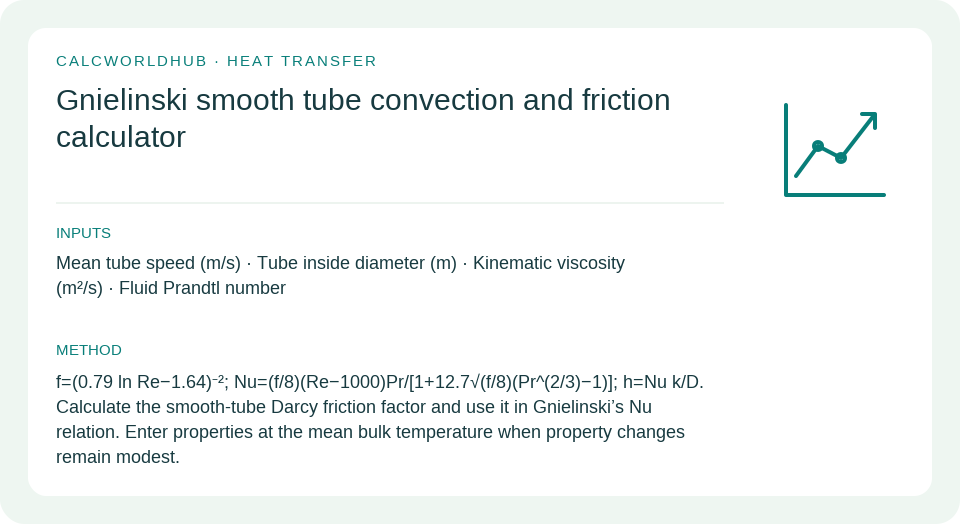
f=(0.79 ln Re−1.64)⁻²; Nu=(f/8)(Re−1000)Pr/[1+12.7√(f/8)(Pr^(2/3)−1)]; h=Nu k/D.
Calculate the smooth-tube Darcy friction factor and use it in Gnielinski’s Nu relation. Enter properties at the mean bulk temperature when property changes remain modest.
Set up the calculation
U— Mean tube speed (m/s)- Bulk-average fluid velocity through the tube cross-section, not the centerline velocity.
D— Tube inside diameter (m)- Circular flow diameter used for Reynolds number, Nusselt number and the heat-transfer coefficient.
nu— Kinematic viscosity (m²/s)- Dynamic viscosity divided by density at the modeled fluid state; sets Re=UD/ν.
Pr— Fluid Prandtl number- Ratio of momentum diffusivity to thermal diffusivity at the same fluid state.
kf— Fluid conductivity (W/m/K)- Fluid thermal conductivity used to convert Nusselt number to h=Nu·k/D.
Limits of this model
Smooth circular tube, developed turbulent flow, approximately constant properties, 3000≤Re≤5×10⁶ and 0.5≤Pr≤2000. Transition-region estimates remain uncertain.
Check this example
Mean tube speed (m/s) = 1.5; Tube inside diameter (m) = 0.02; Kinematic viscosity (m²/s) = 0.000001; Fluid Prandtl number = 7; Fluid conductivity (W/m/K) = 0.6.
- Average fully developed coefficient: 6345.566918 W/m²/K
- Nusselt number: 211.518897
- Darcy friction factor used: 0.023639
- Diameter Reynolds number: 30000
Flow at 1.5 m/s through a smooth 20 mm tube with nu=1e−6 m²/s and Pr=7 gives Reynolds number 30,000. The friction-coupled Gnielinski estimate gives Darcy f=0.0236390 and h=6,345.57 W/m²/K.
Reading the outputs
Returns h, Nu, the Darcy friction factor used by the thermal correlation and diameter Reynolds number.
Frequently asked questions
Is the displayed friction factor Fanning or Darcy?
Darcy. Dividing it by four gives the corresponding Fanning factor.
Does this include thermal entrance enhancement?
No. Use a developed section long enough for the boundary condition assumption.
Can rough pipe data be entered as a roughness?
No. This page uses a smooth-tube friction expression; roughness changes both momentum and heat transfer.
How do I use the Gnielinski smooth tube convection and friction calculator?
Enter Mean tube speed (m/s), Tube inside diameter (m), Kinematic viscosity (m²/s), Fluid Prandtl number, then complete the remaining labeled fields. Match the units shown beside each field and review the result together with the assumptions below.
What is a worked example of Gnielinski smooth tube convection and friction?
Mean tube speed (m/s) = 1.5; Tube inside diameter (m) = 0.02; Kinematic viscosity (m²/s) = 0.000001; Fluid Prandtl number = 7; Fluid conductivity (W/m/K) = 0.6. Average fully developed coefficient: 6345.566918 W/m²/K Nusselt number: 211.518897 Darcy friction factor used: 0.023639 Diameter Reynolds number: 30000 Flow at 1.5 m/s through a smooth 20 mm tube with nu=1e−6 m²/s and Pr=7 gives Reynolds number 30,000. The friction-coupled Gnielinski estimate gives Darcy f=0.0236390 and h=6,345.57 W/m²/K.
Background or definition reference: IIT NPTEL Gnielinski tube correlation.
Read our calculation methodology.