How to use this calculator
Compare three idealized mean-stress fatigue criteria using a proportional scaling factor on both alternating and mean stress.
- Enter Alternating stress amplitude (MPa), Mean stress (MPa), Corrected endurance strength (MPa), Yield strength (MPa), then complete the remaining labeled fields. Match the units shown beside each field and review the result together with the assumptions below.
- Read the worked example below to check the expected input format and result.
- Compare another scenario by changing one input at a time. Use Reset to return to the starting values.
Goodman Soderberg Gerber fatigue load factors explained
How the calculation works
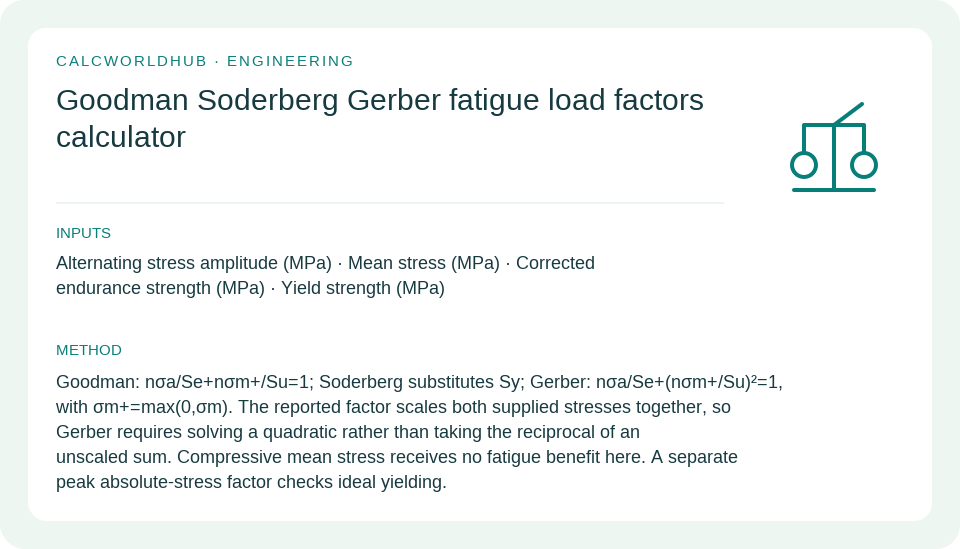
Goodman: nσa/Se+nσm+/Su=1; Soderberg substitutes Sy; Gerber: nσa/Se+(nσm+/Su)²=1, with σm+=max(0,σm).
The reported factor scales both supplied stresses together, so Gerber requires solving a quadratic rather than taking the reciprocal of an unscaled sum. Compressive mean stress receives no fatigue benefit here. A separate peak absolute-stress factor checks ideal yielding.
Set up the calculation
sa— Alternating stress amplitude (MPa)- Half the stress range, not the full range. Supply corrected local alternating stress on the same material basis as Se.
sm— Mean stress (MPa)- Midpoint of the cyclic maximum and minimum stress. Compressive mean stress receives no fatigue benefit in this implementation.
Se— Corrected endurance strength (MPa)- User-supplied corrected endurance strength for the application and material basis. The tool does not infer correction factors.
Sy— Yield strength (MPa)- Material yield strength in MPa on the same stress basis as the entered cyclic stresses.
Su— Ultimate strength (MPa)- Material ultimate tensile strength in MPa on the same stress basis as the entered cyclic stresses.
Limits of this model
Uniaxial stress range and user-supplied corrected endurance data. No notch, surface, size, temperature, multiaxial, finite-life, or reliability corrections are inferred. These diagrams are not a certified component life prediction.
Check this example
Alternating stress amplitude (MPa) = 90; Mean stress (MPa) = 60; Corrected endurance strength (MPa) = 220; Yield strength (MPa) = 420; Ultimate strength (MPa) = 650.
- Modified Goodman proportional-load factor: 1.9944212
- Soderberg proportional-load factor: 1.81176471
- Gerber proportional-load factor: 2.33124797
- Peak absolute-stress yield factor: 2.8
A ninety-MPa amplitude is superimposed on a sixty-MPa tensile mean. Each criterion draws a different limiting curve through the same material strengths.
Reading the outputs
Factors above one indicate room to scale the stated loading within that ideal criterion; they do not establish service safety without the omitted effects.
Frequently asked questions
Is alternating stress the full range?
No. It is half the maximum-minus-minimum stress range.
Does compression improve the result here?
No. Negative mean stress is conservatively clamped to zero for the fatigue diagrams.
Is Gerber factor just one divided by its equation?
No. Both stress components scale with the unknown factor, producing a quadratic term.
How do I use the Goodman Soderberg Gerber fatigue load factors calculator?
Enter Alternating stress amplitude (MPa), Mean stress (MPa), Corrected endurance strength (MPa), Yield strength (MPa), then complete the remaining labeled fields. Match the units shown beside each field and review the result together with the assumptions below.
What is a worked example of Goodman Soderberg Gerber fatigue load factors?
Alternating stress amplitude (MPa) = 90; Mean stress (MPa) = 60; Corrected endurance strength (MPa) = 220; Yield strength (MPa) = 420; Ultimate strength (MPa) = 650. Modified Goodman proportional-load factor: 1.9944212 Soderberg proportional-load factor: 1.81176471 Gerber proportional-load factor: 2.33124797 Peak absolute-stress yield factor: 2.8 A ninety-MPa amplitude is superimposed on a sixty-MPa tensile mean. Each criterion draws a different limiting curve through the same material strengths.
Background or definition reference: MIT fatigue mechanics notes.
Read our calculation methodology.